

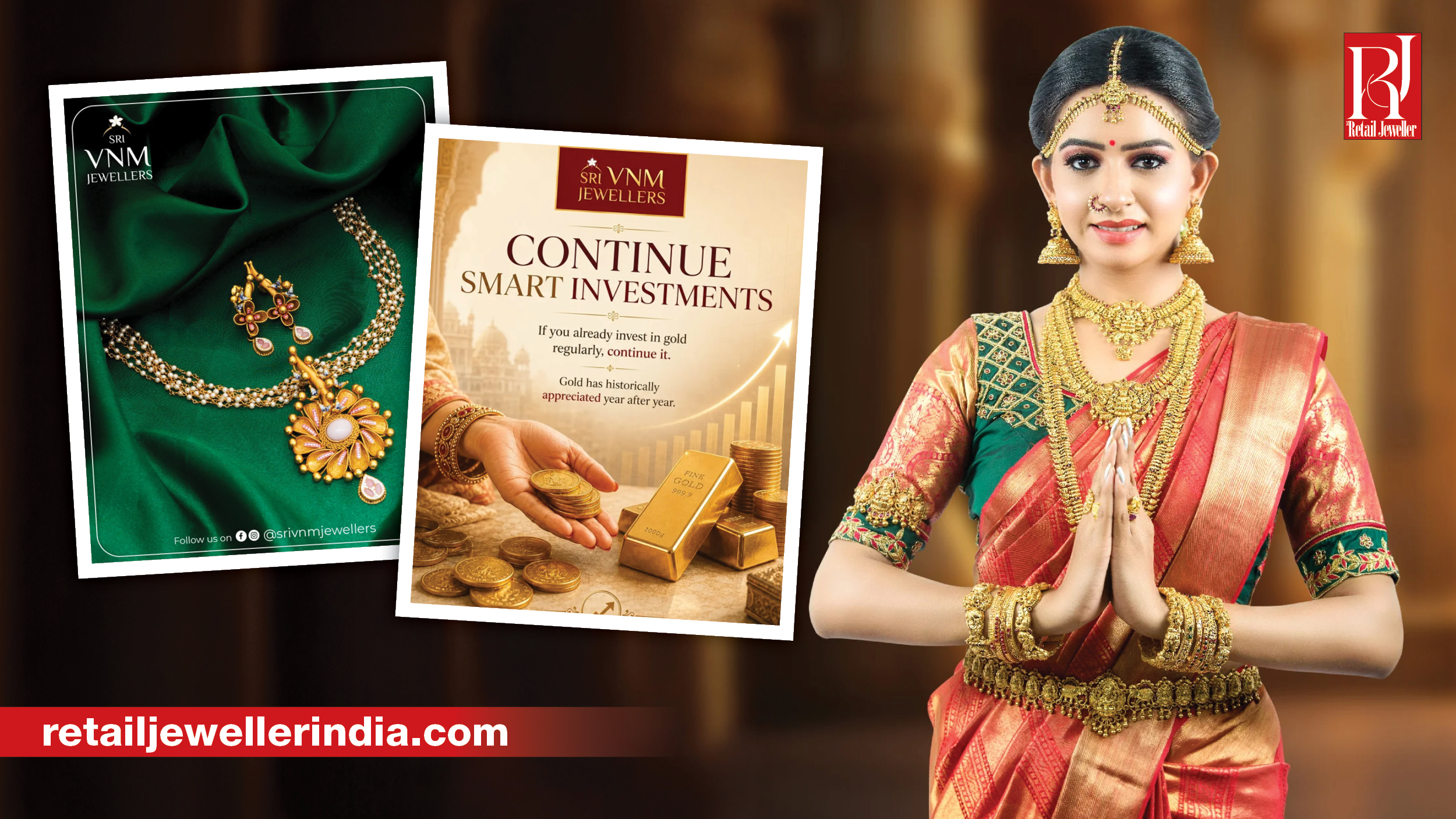

In a city of 15-plus corporate chains, Pondicherry’s Sri VNM Jewellers — a 29-year-old, single-store, mass-market independent — is clocking 15 to 20 percent year-on-year growth, and drawing customers from beyond the city, all powered by one owner willing to show up on camera and talk straight.
Edited Excerpts
Q. Shri V.N.M Jewellers has been a staple in the local jewellery market for nearly three decades. Could you take us back to the beginning? What was the original market gap you sought to bridge?
My father and uncle founded the brand on June 9, 1997. Back then, the Pondicherry market was highly unorganized. The single biggest gap they identified was guaranteed purity and transparency; when we started, we were one of the very few showrooms committed to being 100% BIS hallmarked. We entered the market as a mass-market player catering primarily to the B and C demographics, with a small portion serving the A segment, built entirely on the foundational pillars of uncompromised quality and absolute trust.
Q. You made a massive move, shifting from your original location on Bharti Street to a brand new facility. What prompted that transition?
Bharti Street served us incredibly well, but the lane had become severely congested, and the jewellery market was shifting toward the main lane. Customer convenience is paramount; if a buyer cannot navigate the area easily, you lose them. We took a calculated risk and opened a 3,200-square-foot, two-floor showroom on Kamraj Salai in 2021. The shift paid off spectacularly. Moving to this booming jewellery hub gave us an immense location advantage. Compared to 2020, our customer footfalls increased by 300% (3x), and our sales volume grew 5x.
Q. Pondicherry currently hosts a significant number of corporate jewellery chains. In such a saturated market, how does an independent jeweller like Shri V.N.M Jewellers not just survive, but maintain a strong year-on-year growth trajectory?
The corporate chains bring massive competition, as there are around 15-plus corporate chains in our demographics now, but we have very strong roots and a deeply embedded value system regarding customer service. While standardized compliance like BIS and HUID means purity is now uniform across the industry, the true differentiators are design variety and craftsmanship. We achieve a 15% to 20% year-on-year growth on average because we keep ourselves highly updated with design trends and technology. Given rising gold prices, we focus heavily on engineering lightweight jewellery, ensuring our delivery remains affordable for our mass-market audience.
Furthermore, our internal decisions are entirely data-led. Instead of relying on guesswork, we run a highly structured, system-driven approach where we track which jewellery pieces move, which dealers perform best, and what our customers prefer. This data-driven approach keeps our decision-making agile.
Q. A massive share of your business comes from the Old Gold Exchange. How vital is this channel to your operations?
The Old Gold Exchange is absolutely crucial and represents 50% to 60% of our routine sales. The market has evolved to a point where consumers regularly exchange their outdated pieces for fresh variety. We actively lean into this by introducing specialized Old Gold Exchange Festivals during strategic times when rates fluctuate, inviting customers to swap their gold at premium, transparent advantages.
Q. Founder-led content has proven to be a game-changer for jewellery brands, and your numbers reflect that. What did you do differently that made it work?
Rather than talking about products, I made it personal — knowledge sharing, explaining why we introduced a specific design, why customers should be saving in gold right now. That direct conversation is what changed things. Two years in, digital now makes up 80% of our marketing mix, and the moment a new piece or savings scheme goes live, we get calls and messages almost immediately. Walk-ins have gone up 5 to 8 percent year on year directly because of this. Customers are not just watching — they are walking in ready to buy.
Q. Silverrich today stands as one of the largest displays of silver jewellery in Pondicherry and has expanded 4X since launch. What has been the strategy behind building it to this scale?
Around 2019, as gold prices began climbing steeply, my wife and I noticed that customers — particularly those planning weddings — still wanted rich variety across five or six events but simply could not afford gold for each occasion. We co-founded Silverrich to fill that gap. The range covers Victorian, Designer, Kundan, and heavy Antique pieces — categories we deliberately kept out of our gold offering, so the two brands stay distinct and complementary rather than competing with each other. The other strategic call was to go digital early. Over the last two years, 25 to 30 percent of Silverrich’s sales have come directly from e-commerce, which has allowed us to reach customers well beyond Pondicherry.
Q. Looking ahead, what are the future expansion plans for both the parent company and your silver brand?
For our parent brand, Shri V.N.M Jewellers, we are focusing on expanding our digital footprint. We currently have an app that allows customers to view daily rates and track their savings schemes, and we are planning a full-fledged e-commerce platform for our gold jewellery to break location barriers. For Silverrich, we are currently revamping the website, and within the next five years, we plan to physically expand by launching 3 to 5 standalone flagship stores. Independent jewellers hold a unique advantage: when we innovate and introduce fresh concepts, our community welcomes it with immense energy.
By Maithili Patange
The Retail Jeweller