



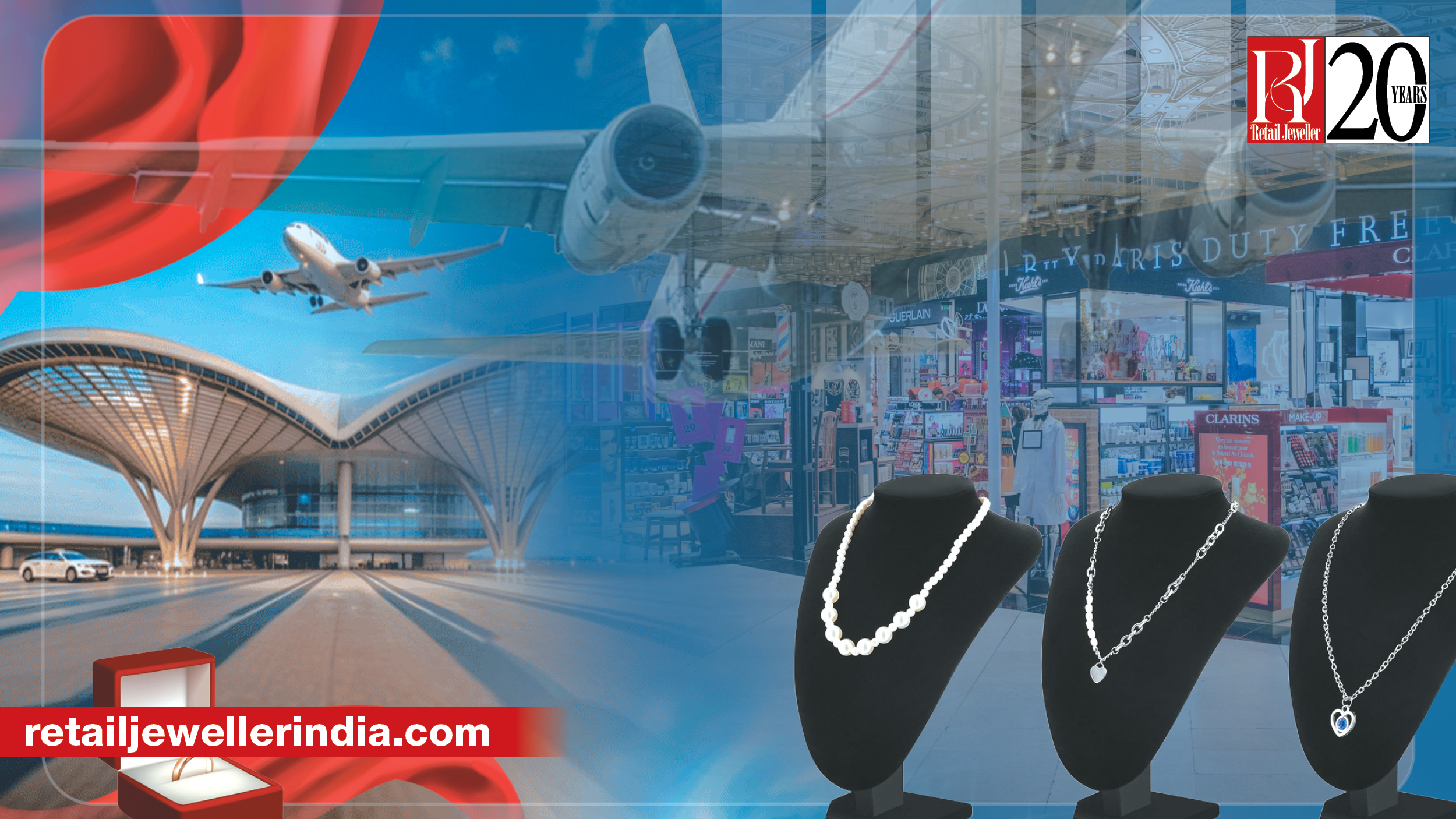

As India’s aviation sector evolves into a commercial lifestyle ecosystem, jewellery brands are exploring their growth channels through retail stores at airports that offer more than transactional potential
Jewellers are adapting product strategy, store design, and customer engagement models to fit the fast-evolving airport ecosystem, while using airport retail not just as a point of sale, but as a strategic touchpoint to amplify brand equity and connect with a national and international audience.
With a sharp rise in domestic and international air traffic, Indian airports have evolved beyond transit hubs into high-footfall, high-intent retail venues. For jewellery brands, the airport is no longer a peripheral outlet—it’s becoming central to how they engage modern consumers on the move.
Aspirational Spaces
Tarang Arora, Creative Director at Tribe by Amrapali sees airports as a high-impact platform for visibility and aspiration. “Airports aren’t just about footfall—they’re where aspiration meets access,” he says. “For a luxury brand, it’s not just shelf space, it’s stage space.” Tribe’s entry into airport retail reflects its broader strategy of meeting its target audience—affluent, mobile, design-conscious buyers—where they are, whether in high streets, online, or in transit.
The appeal extends to ambitious regional players. Rokde Jewellers based in Nagpur, launched its airport store with a clear objective: elevate its brand perception. “An airport store didn’t just increase visibility—it redefined our brand in the eyes of consumers,” says Director Paras Rokde. “From being a regional name, we became part of the national conversation.” Within months, the brand saw stronger recognition among outstation travellers, many of whom would later visit their city store.
Legacy brands are also recognising the airport as a space to build future relevance. S. L. Shet Diamond House, an 80-year-old brand in Mangalore, chose airport retail as a means of targeted brand expansion. “It’s retail with intent, not just footfall,” says Director Sharath Shet. “We’re not just catering to the casual buyer. These are consumers in a decision-making mindset—often looking for meaningful, occasion-driven purchases on tight timelines.”
Transit Buyers
Each brand’s product strategy is closely aligned with its understanding of airport travellers. Tribe by Amrapali has designed its assortment to reflect Indian craftsmanship through silver and lightweight jewellery that’s easy to carry but high in emotional and aesthetic value. “We’re increasingly seeing interest in statement pieces, especially from younger NRIs and international tourists who see jewellery as a way to stay connected with cultural identity,” says Arora.
Rokde Jewellers has found success by leaning into practical luxury—pieces priced between Rs 15,000 and Rs 25,000, suitable for gifting or everyday wear. “We’re targeting professionals who fly frequently—doctors, consultants, even working couples visiting home,” says Rokde. “They’re not looking for elaborate sets, but something elegant, modern, and quick to choose.”
S. L. Shet Diamond House focuses on fast-moving items—gold chains, lightweight bracelets, and watches typically under Rs 100,000. The airport store also serves as a lead generator. “We keep the format tight and the inventory agile,” explains Shet. “If someone wants a bespoke piece, we refer them to our flagship store. It’s a brand touchpoint, not just a sales counter.”
Functional Designs
Designing airport stores involves a fine balance between visibility and function. Tribe by Amrapali uses open displays and modular showcases to enable intuitive browsing. Rokde’s store features mannequins styled with jewellery to create context and inspire add-on purchases. “We wanted a space that feels aspirational but not intimidating,” says Rokde. “People often buy spontaneously at airports. Our job is to make the decision easy.”
S. L. Shet Diamond House has taken a minimalist approach. Their 550-square-foot store is white-themed, flexible, and easy to relocate if terminal layouts change. “You’re designing for mobility as much as permanence,” says Shet. “And every square foot must deliver.”
Airport Complexities
What makes airport retail particularly complex is its operational layer. Regulatory clearances, security checks, and infrastructure approvals can take months. “From initial approvals to final setup, it took nearly two years,” Shet shares. “Each product, each staff member, every delivery truck has to be accounted for and logged. It’s far more layered than traditional retail.”
Rokde Jewellers, too, faced challenges—especially in stock movement and after-sales service. “Unlike our city store, we can’t do instant repairs or exchanges. There are procedural constraints,” says Rokde. However, the brand is optimistic that operations will smoothen with the recent transition of Nagpur Airport’s management to the GMR Group.
Teams Redefined
Tribe by Amrapali has navigated these challenges by embedding compliance and training into its operations. “We invest in onboarding people who understand the environment,” says Arora. “Our staff undergo airport protocol training, but also cultural training. They’re engaging with global travellers in short, high-stakes windows.”
Hiring for airport stores is fundamentally different. Employees need to be multilingual, adaptive, and capable of delivering high-service experiences quickly. Tribe by Amrapali conducts regular etiquette and storytelling workshops, helping staff make emotional connections in a short span of time. Rokde has built its own training modules focusing on hospitality, language skills, and handling premium clientele. S. L. Shet Diamond House, by contrast, deploys pre-trained staff from its main store. “Consistency is key. We want the same brand experience at the airport that someone would get downtown,” Shet notes.
Beyond Daily Sales
Despite higher rents and tighter margins, most of these jewellers report strong outcomes. For Tribe by Amrapali, airport stores deliver higher sales-per-square-foot than some high-street outlets, owing to curated assortments and a highly focused customer profile. Rokde Jeweller’s airport store receives 60–70 daily walk-ins, with average bills ranging between Rs 6,500 and Rs 12,000. “We’ve also noticed something interesting—many airport customers come back to our city store for bigger purchases,” says Rokde.
S. L. Shet Diamond House, while conservative in expectations, sees the store as a branding investment. “Even if we don’t hit high ticket sizes daily, the visibility we get is worth the cost,” says Shet. “It’s like having a billboard—but one that talks back to the customer.”
Marketing efforts are now extending beyond the store perimeter. Tribe by Amrapali has partnered with Singapore Airlines to offer exclusive discounts to its passengers. “It’s about integrating the brand experience into the travel journey,” says Arora. Rokde Jewellers has experimented with co-branded campaigns inside the airport—offering vouchers in collaboration with food and fashion retailers.
“We’re exploring satellite touchpoints within the terminal—think of them as passive ambassadors,” says Rokde. S. L. Shet Diamond House participates in group campaigns led by the Adani Group and leverages visual merchandising to build recall and presence.
Ultimately, airport retail is also a strategic lever, apart from being a revenue stream. It offers brands a chance to test formats, build new audiences, and send strong signals to the market about ambition and scale. For consumers, it creates a seamless, trust-rich way to engage with jewellery in a moment that is often emotional, transitional, and time-sensitive.
“Retailing at airports is not just about the store—it’s a statement of intent,” Shet reflects. And for Tribe by Amrapali, Rokde Jewellers, and S. L. Shet Diamond House, it’s a runway for long-term brand elevation.
Written by Aparna Bhowmick
Retail Jeweller India Magazine