

India’s economy is projected to reach $7.3 trillion by 2030, making it the world’s third-largest.
Per capita income is set to rise from $3,000 to $4,000 by (FY30), thereby transitioning the
country into an upper-middle-income economy. The driver behind this growth is domestic
consumption, which accounts for over 70 per cent of GDP.
And within that consumption story sits a demographic force reshaping markets. As the
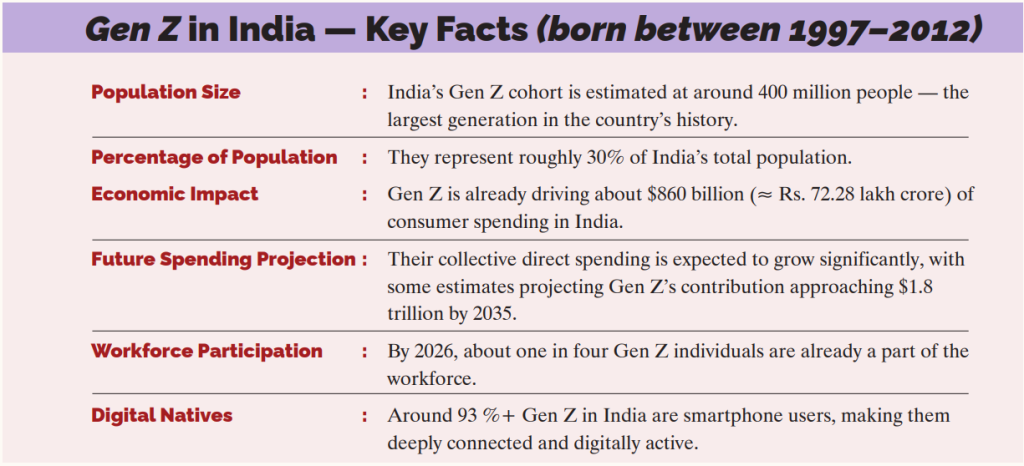
fastest-growing spending force in the country, Gen Z, the first true ‘digital natives’, is actively
redefining the retail landscape and challenging every convention in the retail playbook by rewriting the purchase journey – from motivation to decision.
These consumers are not prospects; they are active today, many making wedding decisions
now. The Gen Z bride is creating her wedding story in her own style, not always conforming to
traditions. Her influence is strengthened by the fact that she is now sharing the financial weight of the bridal budget.
She is deciding not just how much to spend, but what to spend it on. She is, in equal parts,
budget-sure and budget-smart about her choices. She is considering the experience, value,
and utility of the available options, and she must shape how jewellers approach their future
strategy for the bridal market. To understand the industry’s current bridal business model and
its readiness to respond to the Gen Z bride, The Retail Jeweller conducted a national survey
of 150 retail jewellers across India.
Data reveal the industry’s bridal sector is in good health, with 85% of retailers reporting business growth or stability, and the majority – 66% of retailers – have a robust pre-bridal marketing strategy to attract new brides. But the most striking and surprising finding is that the bridal business is no longer existential for a majority of jewellers; 64% of retailers are diversifying and generating significant non-bridal revenue, likely driven by the increasing importance of jewellery as a personal lifestyle accessory.
This is especially true for Gen Z, who view products as extensions of their identity, making design (style) and wearability (post-wedding utility) the primary factors influencing their final purchase decision, according to the survey. Interestingly, despite 84% of jewellers confirming that digital discovery of their brand has increased, nearly 52% report an increase in bridal sales from repeat or generational families, according to the survey. The paradox resolves when we distinguish discovery from decision. Brides may discover widely through digital platforms and peer networks, but the final transaction, especially in bridal, still has a high chance of returning to the trusted family jeweller.
Even so, as discovery expands and potential brides have a plethora of choices to evaluate, the prepurchase digital battle is a must-win for survival. For legacy brands, the takeaway is clear – digital trust must precede physical presence. The digital investment must be paired with aggressive trust-building plans and legacy communication, experience, and engagement at the discovery stage to capture both new market entrants who may not have established loyalties and repeat family pipelines, transitioning online exploration to offline stores. Even though this generation is highly characterised by ‘browsing’—digital–first discovery through social media —and now even by AI engines, relying heavily on peer-generated content, such as reviews and recommendations, ‘showrooming’ remains a critical part of how this generation blends the two media before making the final purchase decision.
For a category that is a high-involvement purchase due to its ticket size, personal sentiment, and enduring value, this nuanced behaviour in a crowded digital space opens a wide window of opportunity to offer experiences that online shopping cannot match. At the store, with 62% of retailers reporting the bridal agency in jewellery purchase growing- a uniform trend across the country, there has to be a shift in approach to make the bride and not the family, the centre of the conversation. The bride who feels heard in the store becomes its most powerful advocate. One of the most crucial survey revelations is the dismal number of brides requesting customisation, with ready-to-wear inventory still dominating. It is counterintuitive to brides arriving ‘very clear and specific on their selection and concept’, much of it based on Pinterest boards or Instagram exploration, as reported by jewellers.
This could be masking industry gaps that have yet to leverage this service’s full potential. In an evolving ecosystem where the bride is cocreating not just her attire but also her wedding, extending the idea to jewellery is not implausible. For the industry, a structured, full-scale customisation model, now supported by AI visualisation and 3D technology, can become a mega-capital and a megacompetitive edge. However, it was designed to serve customers above a certain price threshold to justify the complexity. Investing in this infrastructure offers relief from rising inventory costs while deepening the bride’s engagement with the category as she co-creates her dream design.
The dual benefit is that when this trust-based ‘consultation’ transforms the ‘transaction’ into a meaningful ‘conversation’, it greatly increases the customer’s lifetime value beyond the wedding purchase. The implications for independent retailers are significant. Independent retailers hold advantages – generational relationships, community trust, decades of craftsmanship equity. Yet, these advantages only translate into business if the retailer adapts to meet the bride where she is. Nearly one-third of the jewellers surveyed report business stability over the last calendar year. 32% of retailers also report that brides’ budgets remain stable (within the expected range), while another 36% report a decrease in budgets (from the expected range).
The finding has multiple implications for the industry and individual businesses. The bride is no longer buying her bridal jewellery from a single jeweller; the budget is dedicated to the design and split across jewellers. There is also a more concerning possibility that overall jewellery spending, relative to other rapidly increasing bridal expenses- clothing, photography, décor, etc., is unchanging or diminishing. In a rapidly expanding bridal market—projected to grow from approximately US$105 billion in 2024 to over US$290 billion by 2030, with average wedding expenditures increasing by 8% annually (BW)— remaining stable may indicate a loss of market share, especially as a large group of enthusiastic Gen Z brides enters the market.
The bride has advanced, and the market has grown. To retain jewellery’s relevance and share in the bridal market, the industry has to remain nimble-footed and agile, not just rethinking but reinventing the bridal business model, making the path from discovery to shopping more experiential and non-transactional. For the jewellery industry, which has long relied on trust as its main pillar for growth, change has been met with little enthusiasm. Gen Z’s non-linear approach and behavioural nonconformity to past generations serve as a wake-up call for jewellers to go beyond traditional success models and rewrite the bridal retail playbook.
According to reports, 79 per cent of couples funded their weddings through their savings, while 15 per cent took loans. WedMeGood’s 5th Annual Wedding Report 2025 (survey of 2000 couples).
Please note: This survey focuses specifically on independent retailers because their path forward is distinct and their challenges are unique.
Respondent
Profile
Total Sample
Geographic Coverage
4
Regions across India
City Tier Coverage
Metro, Tier2 and Tier3 cities
Business Formats
SINGLE
STORE
LOCAL FAMILY JEWELLERS
REGIONAL CHAINS
NATIONAL
KEY findings
| GROWTH | 85% | of all jewellers saw stability and moderate-to-significant business growth last year |
| 85% of retailers reported growth or stability — the sector is in good health | ||
|
CATEGORY CONTRIBUTION |
64% | of retailers report bridal contributes less than 50% of total business — a majority have meaningful non-bridal revenue |
| Non-bridal jewellery is the industry’s new growth engine | ||
| LOYALTY | 81% | of retailers report that the contribution of repeat or generational bridal families to their business has increased. |
| Trust remains the cornerstone of bridal purchases across generations | ||
| NEW BRIDES | 97% | of retailers have gained new bridal customers in the last year, reflecting a healthy acquisition pipeline |
| Near-universal customer acquisition signals a strong and expanding market | ||
| ACQUISITION | 66% | of retailers report having a structured strategy to acquire bridal business |
| Pre-bridal marketing is now a mainstream practice among independent retailers | ||
| DESIGN FIRST | 47% | of retailers say design is the single most important factor at the final purchase decision stage |
| Design + Value for Money + Brand Trust collectively account for 93% of all final decisions | ||
|
GROOM MARKET |
53% | of retailers say they have seen growth in the men’s bridal market — an emerging category nationwide |
| Metro groom market leads at 65% vs 46% in non-metros — significant untapped upside | ||
| GOLD IMPACT | 63% | of retailers say rising making charges linked to gold value negatively impact the value-price equation, affecting sales |
| Making charge impact is near-uniform across metro (62%) and non-metro (64%) retailers | ||
| OPTIMISM | 77% | of retailers expect double-digit growth (10%+) in FY 2026–27, reflecting strong sector confidence |
| Non-metros are more bullish — 39% expect 20%+ growth vs 28% in metros | ||
Bridal Market Survey 2026 · National Sample (n = 150) · Retail Jeweller India
METRO
KEYfindings
|
DIAMOND CATEGORY |
84% | vs Non-Metro: 64% (20% higher than Non-Metro) |
| Metro retailers report diamonds as the top contributing category in their bridal inventory | ||
|
GROOMS DEMAND GROWTH |
65% | vs Non-Metro: 46% (19% higher than Non-Metro) |
| Metro retailers report growing demand for groom’s jewellery | ||
|
GOLD SAVINGS PLAN |
35% #1 scheme | vs Non-Metro: 23% (12% higher than Non-Metro) |
| Metro retailers report gold saving as the no. 1 conversion scheme | ||
|
BRIDAL CONTRIBUTION (0–25%) |
29% | vs Non-Metro: 10% (19% higher than Non-Metro) |
| Metro retailers have lesser dependency on bridal — metros are more diversified | ||
|
GOLD PRICE RESILIENCE |
41% | vs Non-Metro: 32% (9% higher than Non-Metro) |
| Metro retailers report no impact or increased volume despite rising gold prices | ||
|
PROMOTIONS RELIANCE |
57% | vs Non-Metro: 41% (16% higher than Non-Metro) |
| Metro retailers rely on promotions to acquire new bridal business — above national average of 47% | ||
Bridal Market Survey 2026 · Metro Sample · Retail Jeweller India
NON-METRO
KEYfindings
|
BRIDAL DEPENDENCY (25–100%) |
89% | vs Metro: 71% (18% higher than Metro) |
| Non-metro retailers have high to moderate dependency on bridal jewellery | ||
|
RATE PROTECTION |
35% #1 scheme | vs Metro: 24% (11% higher than Metro) |
| Non-metro retailers cite rate protection as the single highest scheme favouring bridal conversion | ||
|
NEW BRIDES (25–50)% |
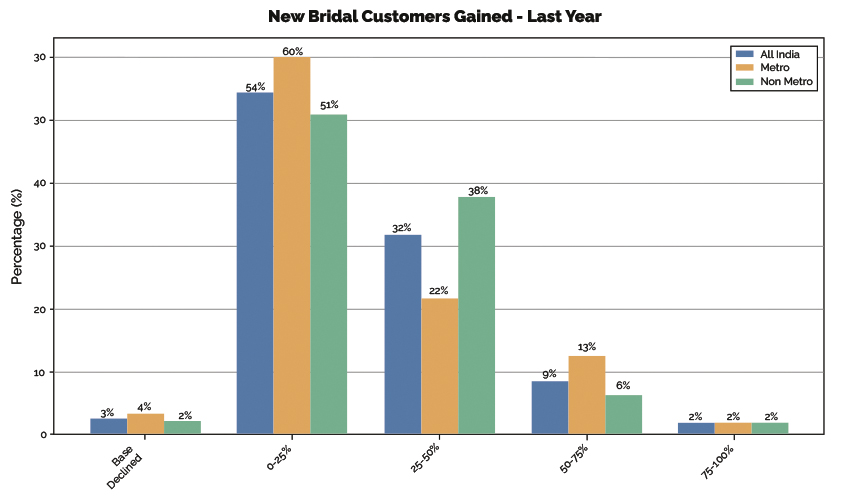
38% | vs Metro: 22% (16% higher than Metro) |
| Non-metro retailers report high growth in new bridal customers | ||
| BRIDAL SPENDS | 70% | vs Metro: 54% (16% higher than Metro) |
| Non-metro retailers report stable or increased bridal budgets over the last 3 years | ||
|
PRE-DEFINED BUDGET (60–80)% |
45% | vs Metro: 29% (16% higher than Metro) |
| Non-metro retailers report significant portion of their brides walking into the store with predefined budgets | ||
|
IN-STORE ACTIVITIES |
20% | vs Metro: 7% (13% higher than Metro) |
| Non-metro retailers create engaging in-store occasions to demonstrate bridal offerings | ||
|
JADAU PROMINENCE |
53% | vs Metro: 42% (11% higher than Metro) |
| Non-metro retailers rank Jadau as 3rd most important category — an unexpected finding | ||
Bridal Market Survey 2026 · Non-Metro Sample · Retail Jeweller India

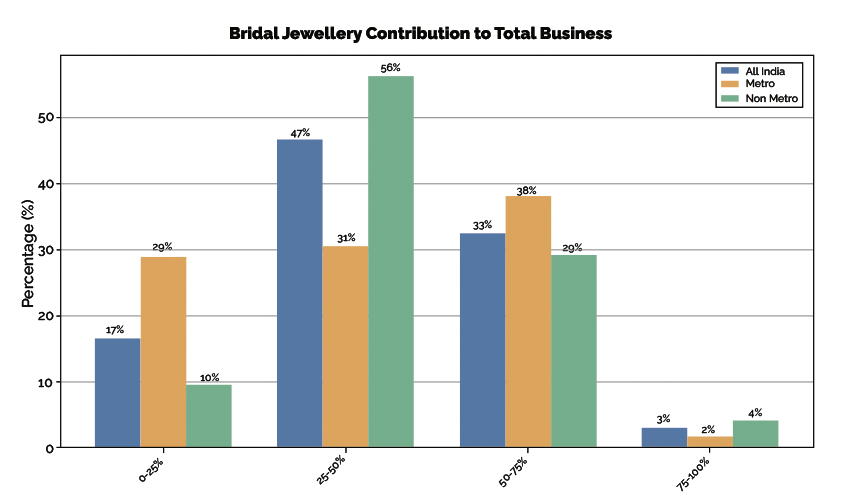
Bridal Contribution to Total Business
What percentage of total business comes from bridal jewellery?
Key Findings:
– 64% of retailers’ nationwide report that bridal sales contribute less than 50% of total business — a majority have meaningful non-bridal revenue.
Metro vs. Non-Metro:
– 29% Metro vs. 10% Non-Metro retailers report bridal contributes less than 25% to their overall jewellery business.
Metros are inherently more diversified, with a broader range of categories, which contributes to turnover. Lower bridal dependency signals the actively growing segment of ‘lifestyle jewellery’ that is more wearable and lends style. For non-metro retailers, higher bridal dependency is a concentration risk.
Analysis and Action Points:
Remarkably, bridal jewellery is no longer a high-dependency category for most jewellers across India. The non-bridal category is the industry’s new growth engine, and jewellers targeting more frequent purchases are expanding their inventories. This trend indicates how jewellery is increasingly integrating into the fashion scene, promoting personal expression and style. As the gold price rises and per-piece value increases, non-bridal jewellery promises higher turnover with better capital efficiency.
If non-bridal is indeed the high-churn, high-contribution category, retailers need to align their business focus accordingly:
- – Allocate space, spend, and inventory as per its contribution to the business.
- – Tailor strategy to increase the lifetime value of the customer — attract younger, pre-marriage customers and drive incremental post-bridal sales.
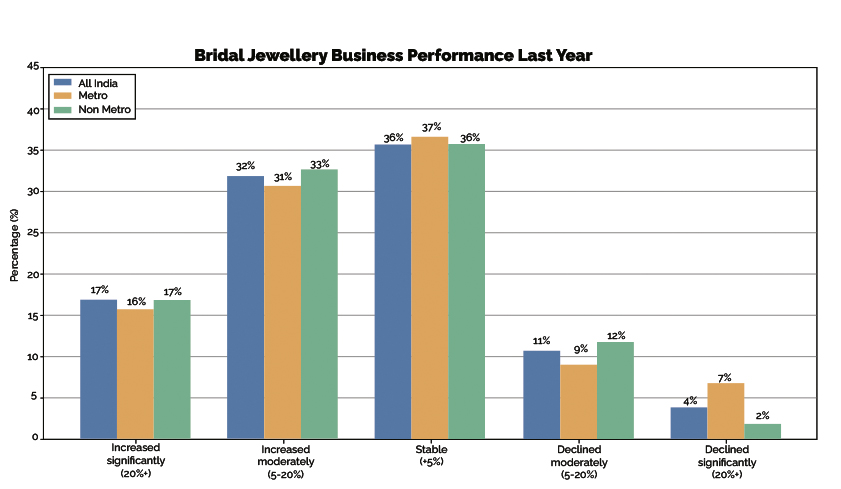
Business Performance 2025
How has your bridal jewellery business performed in the last calendar year?
Key Findings:
- – 85% Retailers report business growth or stability.
- – 49% of jewellers report business growth; 17% significantly (20%+) and 32% moderately (5-20%).
- – Only 15% retailers report a decline in bridal jewellery business.
Metro vs. Non-Metro:
- – 47% Metro vs. 50% Non-Metro jewellers report growth in the range of (>5-<20%).
Metro and non-metro areas are showing a similar pace of growth, despite metros being India’s primary economic centres and growth engines.
Rapid Urbanisation:
India’s urban population is expected to grow from 522 million in 2023 to 951 million in 2050. By 2030, urban areas are projected to account for 75% of India’s GDP (currently 40-60%), driven by increased migration and economic activity in metropolitan areas. Delhi, Mumbai, Kolkata, Chennai, and Bangalore are India’s primary mega-cities, driving urban expansion and over 60% of national GDP.
Source: Revision of the World Urbanization Prospect, CBRE & CREDAI Report
New Bridal Customers Gained
What percentage of new bridal customers have you gained over the last year?
Key Findings:
- – 97% of retailers report maintaining or growing their bridal customer base.
- – The majority gained customers in the range of below 25%.
- – 41% gained new customers in the healthy range of 25%–75%.
- – Only 11% gained over 50% new customers.
Analysis and Action Points:
The bridal market continues to grow, with most retailers experiencing growth and gaining customers. Overall, the market remains healthy, but those reporting stable performance might be losing market share relative to the expanding market, as the overall bridal sector grows without boosting their business growth. While both metro and non-metro markets show similar growth trends, metro areas encounter slightly more pressure than non-metro regions.
This showcases the urbanisation paradox: Metro India is attracting millions of new working-age, high-income consumers annually, driven by population, demographics, and urban growth factors. Yet independent jewellers in metro areas are gaining new bridal customers more slowly than their non-metro counterparts, who are operating in markets with slower overall growth.
Tap into the migrant population:
- – Promote ‘brand legacy’: Think of a compelling video that captures the brand’s history, values, and milestones, building trust and connecting emotionally with those unfamiliar with the brand.
- – Build a community: Explore vibrant cultural events — help newcomers to the city dive into local traditions, festivals, and gatherings that help them belong to the city.
- – Extraordinary sales pitch: Train the sales staff to identify and deliver a more persuasive pitch to these bridal customers.
- – Special service/policies for mobile cohorts: Assured post-purchase services if they move out of the city (promoted across the website and physical stores).
- > Local, quick repair facilitation across multiple cities (through tie-ups with local manufacturers).
- > Free logistics and insurance support.
- > Speedy buy-backs with immediate online transfers.
- > Online-assisted shopping during exchange, with assurance of store inventory availability online.
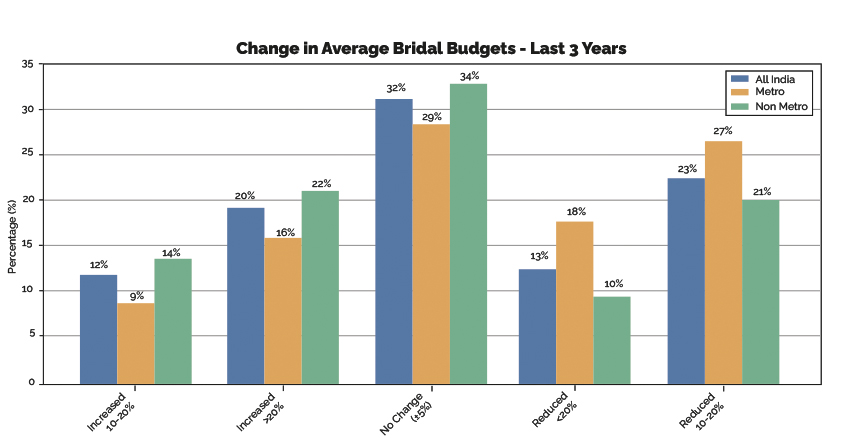
Change in Average Bridal Budgets
How have the average bridal budgets changed over the last 3 years?
Key Findings:
- – 64% of retailers report stable or increased bridal budgets. The market is not in widespread budget compression.
- – 20% report budgets increasing by over 20% — a meaningful premium-growth cohort.
Metro vs. Non-Metro:
- – 25% Metro vs. 36% Non-Metro retailers report budget growth in the bridal jewellery spend.
- – 45% Metro vs. 31% Non-Metro retailers report budget compression in the bridal jewellery spends.
The metro markets show higher budget compression. Non-metro budget growth is more pronounced, with more retailers reporting increased budgets than in metros.
The bridal sector is expected to grow from roughly US$105 billion in 2024 to over US$290 billion by 2030, with average wedding spends rising. (Source: TechSci Research)
NOTE:The survey does not include the average bridal ticket size. It concentrates on overall trends in the bridal segment, regardless of purchase amount.
Analysis and Action Points:
As India transitions from a developing to a developed economy and gold prices continue to rise, markets may bifurcate into two main groups: those pursuing ‘premium experiences’ as they climb the value chain, and those seeking ‘better value.’ Be prepared for both scenarios, or choose your niche. This bimodal pattern calls for a dual strategy that uses a layered approach to effectively target these two distinct segments. Additionally, a decline in jewellery budgets could reflect a broader market trend in which customers split their bridal budgets across jewellers rather than a direct reduction in bridal expenditure.
- – Establish authority: The bride might be allocating her budget across different jewellers based on their specialities, without reducing the total spend. Position your brand as a comprehensive bridal jeweller.
- – Build ‘Instagrammable’ moments: The bride is allocating budgets to experiential spends — embed bridal jewellery in such moments. Create reveal moments for jewellery.
- – Create ‘value luxury’ collections: Modern youth prioritise quality over quantity. This presents an opportunity to show premium designs with compelling backstories, enhancing the purchasing experience and elevating jewellery to a true luxury status at attainable price points.
- – Narrate the intangible value attributes: Youngsters are reducing spending on tangibles. Communicate the inherent value of precious jewellery, which sets it apart from other tangible buys for the occasion. Create a unique consideration set for bridal jewellery — sentimental heirloom, store of value, ultimate status, enduring style (less fleeting than fashion).
- – Build experience over excess: The valuable segment of those with increased budgets needs an environment that matches their aspirations. While most jewellers currently focus on experiential stores, consider making the bridal jewellery purchase itself an experience, regardless of the purchase value.
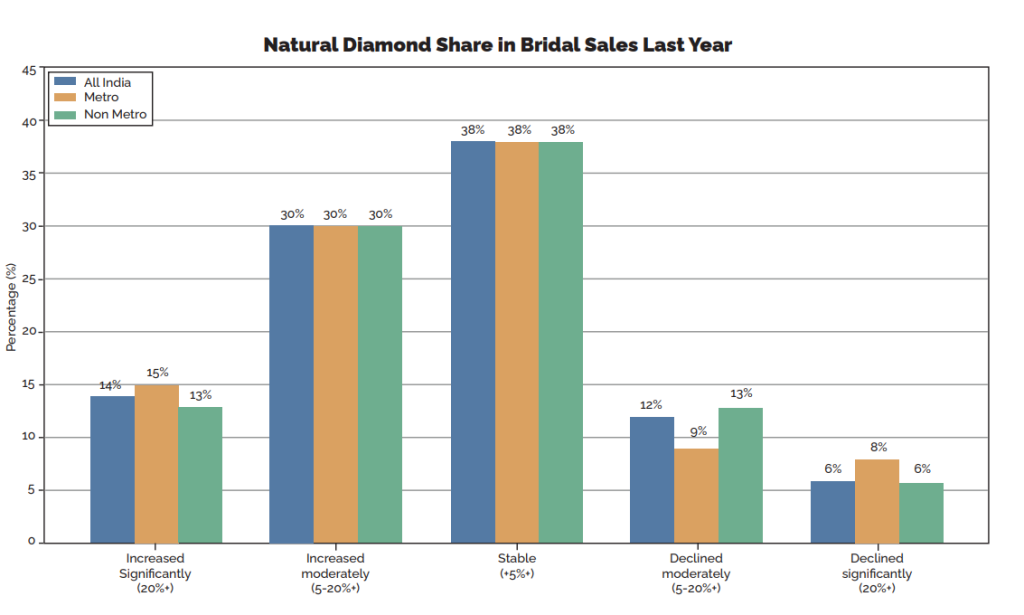
Natural Diamond Share in Bridal Sales
How has natural diamond’s share in your bridal sales changed over the last year?
Key Findings:
- – 44% retailers report growth in natural diamond’s bridal sales share — 30% moderately, 14% significantly.
- – Only 18% retailers report a decline in natural diamond’s bridal sales share.
Analysis and Action Points:
Natural diamonds maintain a resilient position in the Indian bridal market, with sustained consumer preference for natural diamonds in wedding jewellery. Diamonds growth in the bridal basket is a pan-India phenomenon driven by aspirational desire rather than income and geography. The consistency is remarkable and validates continued investment in diamond bridal marketing across all tiers.
- – Diamonds showcase: Partner with bridal couture designers for trunk shows where diamonds are styled with bridal wear.
- – Diamond lifecycle program: Create a 3-event journey: 1. Engagement Diamond Night, 2. Bridal Upgrade Session, 3. Anniversary Offer. Turn one diamond purchase into a lifecycle ladder.
- – Diamond advocacy from past buyers: Invite past brides who bought diamonds to share their stories.
- – Consultation campaign: Run campaigns inviting brides to book a ‘Diamond Consultation.’ Make it appointment-led, not walk-in-led. Curate the store experience with reserved parking, complimentary beverages, gift hampers.
- – Diamond capsules: Curate lighter, statement diamond bridal capsules for multi-occasions and launch them through themed events.
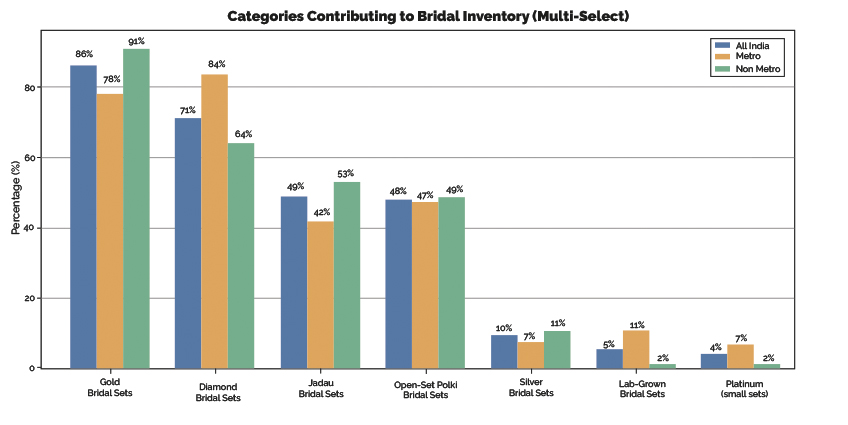
Inventory Mix
Bridal Sets Composition
Select the categories that constitute your bridal necklace-set inventory.
Key Findings:
- – Gold bridal sets are near universal.
- – Diamond bridal sets are dominant in metros, and have achieved remarkable penetration in small towns.
- – The striking finding is the inversion between metro vs non-metro on gold vs diamond. Non-metros lead with gold (91% gold vs 64% diamond) and metros lead with diamonds (84% diamonds vs 78% gold).
- – Jadau and Open-set Polki are in nearly half of all jewellers’ inventories; it’s moved from niche to mainstream.
- – Lab-grown bridal is making inroads in the metros, a niche yet to penetrate small towns.
- – Silver bridal is gaining popularity in non-metros.
Analysis and Action Points:
On Jadau and Open Set Polki: Both are seeing almost equal representation across metros and non-metros. This category sits at the intersection of gold value and design appeal, allowing them to be marketed on both fronts.
- – Maximise value: It is a high-margin segment that requires careful positioning to enable consumers to obtain value by balancing the gold component while adding colour gemstones and polka for modernity and flair. Given the rising cost of gold, this category offers relief, as gemstones add a volume-enhancing design element, but consumers may seek investment value. Structuring transparent buy-back, returns, and exchanges will further strengthen the appeal.
On Silver: It lags behind in metros as these markets have yet to look at the full potential of the category. The dismal representation of the metal in the bridal segment is a sign of ‘wasted opportunity’ and not ‘missed opportunity’. It can be upgraded to investment-grade status, like gold.
- – Bridal Silver corner/brand: Silver is the sunshine category. Launch a separate store under a new silver sub-brand stocking the full range, including bridal. If not, start with a separate bridal section in the showroom.
- – A new commercial framework: Elevate the value of metal to gold’s premium status by creating silver EMI plans, clearly communicating buyback and exchange values, and guaranteeing certified purity. This approach to selling silver encourages customer loyalty and generates recurring revenue, rather than just single fashion transactions, especially with bridal purchases.
- – Favourable gold upgrade plans: Introduce rewarding plans for consumers buying bridal silver jewellery to encourage them to move up the value chain to gold or diamond.
On Diamonds: The category’s growth maintains consistent momentum in both non-metro and metro areas, despite having a smaller presence in non-metro jewellers’ inventories. This presents an opportunity to expand the category’s share in the overall bridal basket.
- – Cultivate aspiration: Introduce high-fashion bridal diamond jewellery campaigns. Prepare a look-book, celebrity-style guides to drive aspirational purchases at the point of sale.
- – Bundle offers: Do multi-assortment packages for brides purchasing both gold and diamond bridal sets.
- Special incentives: For brides buying bridal diamond sets above a certain value, offer unique rewards (not discounts).
- – Curate introductory designs: Offer a selection of youthful bridal designs at affordable prices to attract fence sitters who haven’t yet thought about diamond jewellery sets for their wedding trousseau.
On Lab-Grown: Lab-grown diamonds are rarely offered as an option for brides in non-metro areas. As consumers become more aware, every diamond jewellery retailer must decide their stance on lab-grown diamonds for customer inquiries. Whether a jeweller stocks them or not, have a clear, trained response when a bride asks.
- – Diversify portfolio: Jewellers looking to expand may consider a new lab-grown brand for bridal jewellery. It will have novelty value for budget-tight customers.
- – Pair silver with lab-grown: Jewellers are beginning to pair silver with natural diamonds. Doing the same with lab-grown will create more value at affordable prices.
- – Think ‘honeymoon trousseau’: Create occasion-based ranges, promising style at low risk and cost.
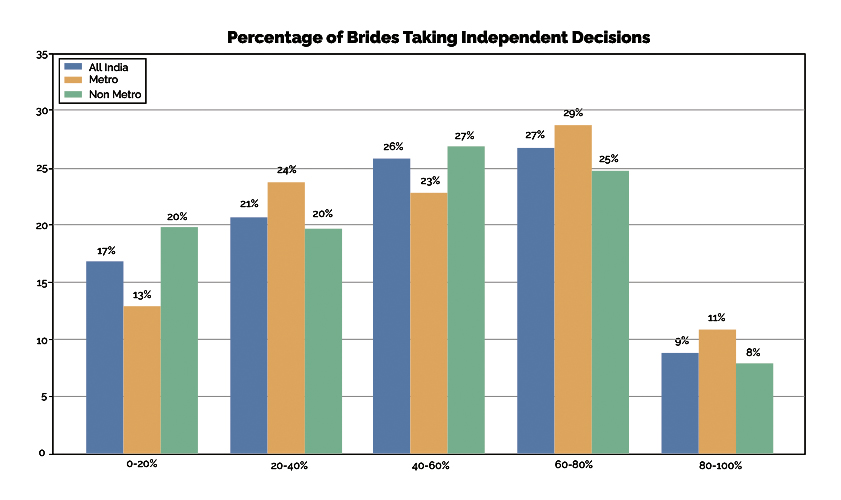
Bride Autonomy in Decision-Making
What percentage of bridal jewellery buying decisions are primarily led by the bride herself?
Key Findings:
- – 62% of retailers report that a considerable number of brides are driving the purchase decisions independently.
- – 36% of retailers report that over 60–100 percent buying decisions at the store are being led by the bride.
Analysis and Action Points:
The bridal agency in jewellery purchases is a uniform trend across the country. The trend is slightly more pronounced in metros than in non-metros. It has a direct, underappreciated implication for how retailers structure their bridal strategy across the board. The retailer who builds direct relationships with the bride while family influence remains present will have both the bride’s preference and the family’s trust.
- – Make the bride feel heard: Redesign consultation model to place the bride as the primary decision-maker. Train salespeople to open the conversation by first discussing her preferences, before addressing the family’s perspective. The bride who feels heard in the store becomes the most powerful word-of-mouth channel.
- – Build bride-specific campaigns: Communication that stokes her independence — ‘Your wedding. Your jewellery. Your choice.’
- – Build the bridal tribe: This generation often exhibits ‘horizontal conformity,’ seeking peer validation and a sense of belonging through shared interests, values, and digital platforms. To foster this, create pre-bridal WhatsApp groups or fun in-store events that help future brides feel part of a community sharing experiences and information.
- – Bridal referral programs: Referrals are highly effective for Gen Z, who value authentic, peer-driven recommendations over traditional advertising, making referral marketing a low-cost, high-conversion strategy.
- > Digital-First Approach: Referral programs must be simple, mobile-friendly, and easy to share. This generation prefers seamless, one-tap mobile experiences for sharing, often leveraging social-friendly links.
- > Incentive Structure: Dual-sided rewards (benefiting both the referrer and the referee) are most effective for motivating this demographic.
– Create in-store bridal touchpoints: Instagrammable bridal-themed fun backdrops — brides browsing designs in-store should feel confident sharing their visit or design choices with friends. A jeweller needs to weigh the opportunity cost of user-generated promotion versus the benefits of keeping the design discreet at the store with limited foot traffic.
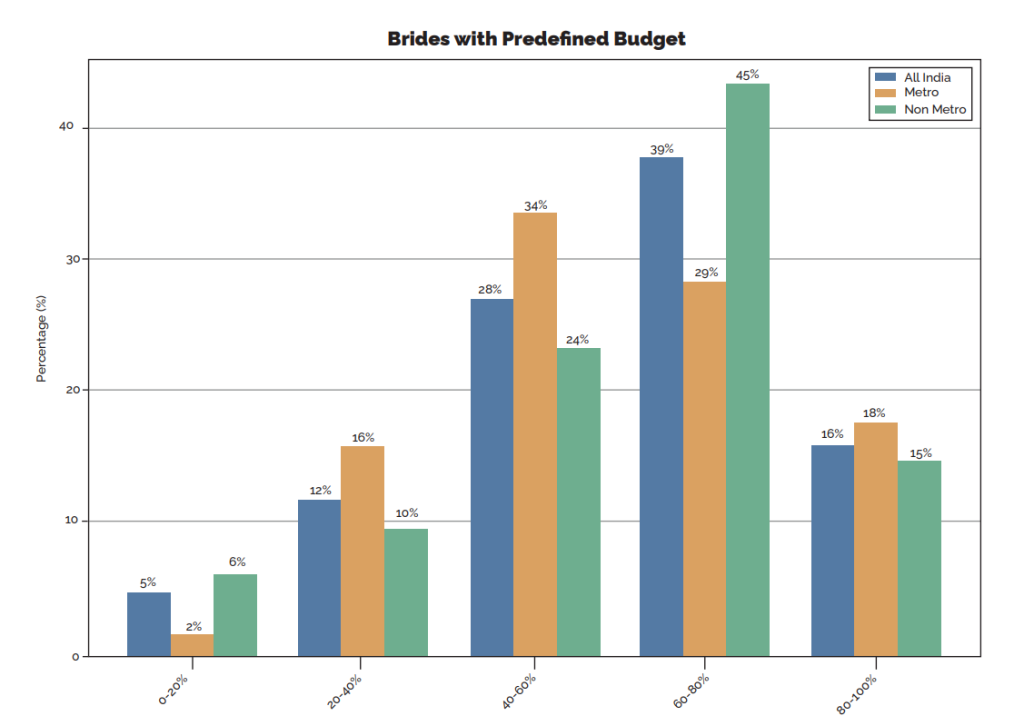
Brides with a Predefined Budget
What percentage of brides walk in with a predefined jewellery budget?
Key Findings:
- – 55% of retailers note that a significant proportion (60-100%) of brides arrive with a predefined budget.
- – 17% of the retailers note that over 60% of their brides come without any specific budget.
Metro vs. Non-Metro:
- – 29% Metro vs 45% Non-Metro jewellers report that 60-80% of the brides walking into the store arrive with predefined budgets.
This creates a more fertile upsell environment for the metro retailer, who can convincingly demonstrate design value and move brides above their initial estimate. Non-metro’s more budget-constrained consumer base means value communication — not just design aesthetics — is the primary conversion tool.
Analysis and Action Points:
More brides are coming budget-sure, even though there is still a favourable segment that comes unprepared. A budget-aware customer is not necessarily product-fixated. Given the current price level of gold, there is a significant opportunity for jewellers to present more profitable categories of diamonds and polka jewellery within the same budget for comparative shopping. The latter can be targeted with premium collections or positioned for upselling.
- – Build price-sorted ranges: For each category, maintain clear price-based ranges. Also, experiment with cross-category price ranges. Keep a small multi-category selection within the range; if brides arrive budget-conscious, they scan quickly, and staff find it easier to do comparative selling and show greater value in non-gold categories.
- – Create price-based catalogues: A showroom or catalogue organised by price range — ‘under Rs. 2 lakh,’ ‘Rs. 2-4 lakh,’ ‘Rs. 4 lakh and above’ — reduces friction for budget-conscious buyers and helps sales staff anchor the conversation at the appropriate level before attempting to move upward.
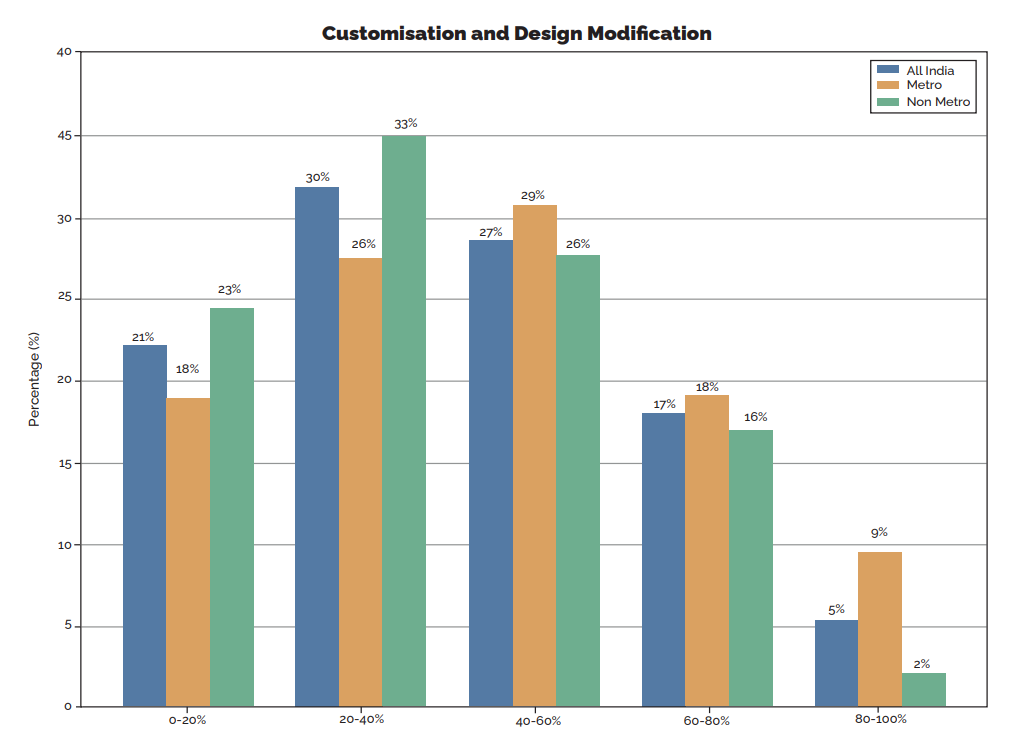
Customisation Expectations
What percentage of brides expect customisation or design modification?
Key Findings:
- – 51% of retailers report that less than 40% of their brides expect customisation — ready inventory still serves the majority.
- – Only 22% of retailers report 60-100% of brides asking for customisation — high-customisation is still the minority experience nationally.
Analysis and Action Points:
Indian Gen Z actively co-creates products by acting as both consumers and creators, shifting from passive buying to shaping designs. They prioritize unique items over one-size-fits-all products and prefer brands that allow them to express their individual identity. Data suggests that some are willing to pay a slight premium to reflect their personal style. Yet, most retailers serve brides who are happy with near-ready inventory. However, in the bridal segment, against the backdrop of rising inventory costs and a deeper desire among zoomers for personalised designs, it is imprudent to ignore the opportunities for customisation, making a blended strategy optimal: a deep ready-to-wear inventory for the majority, with a clear, visible customisation pathway for the rest.
- – Bridal Customisation-as-capital-strategy: The customisation data has a dimension that goes beyond consumer preference; it is an inventory capital strategy. At current gold prices, maintaining a deep finished inventory of bridal sets is increasingly expensive. Retailers who can shift a portion of their bridal business to a customisation model significantly reduce their working capital exposure.
- > Build a Structured Customisation Studio: The critical qualifier is ‘structured.’ Customisation that feels like improvisation erodes the confidence and gratification. Structured customisation that looks professional and reliable converts at a premium.
- > Promote your customisation capability digitally: Video content showing the design-to-delivery journey. From customer brief to CAD preview to AI visualisation to finished piece, this is the most compelling form of pre-bridal marketing available. It answers the question every bride has: ‘Can they actually make what I have in my head?’
- > ‘Build Your own’ testimony: Get happy brides to flaunt their creative aesthetics and take pride in having ideated the design for the d-day.
- > Launch customization campaigns: Suggested campaign lines: ‘Get the design of your dreams’, ‘Your Vision, Our Craft. Customised for You’, ‘Every Detail, As Unique as You’, ‘From Dream to Design’.
- > Wedding-Family Buying Scheme: Introduce a wedding family code, similar to discount or coupon codes, that enables jewellers to identify the shopping as part of a single-family purchase. Ensure these are online, mobile-friendly and shareable.
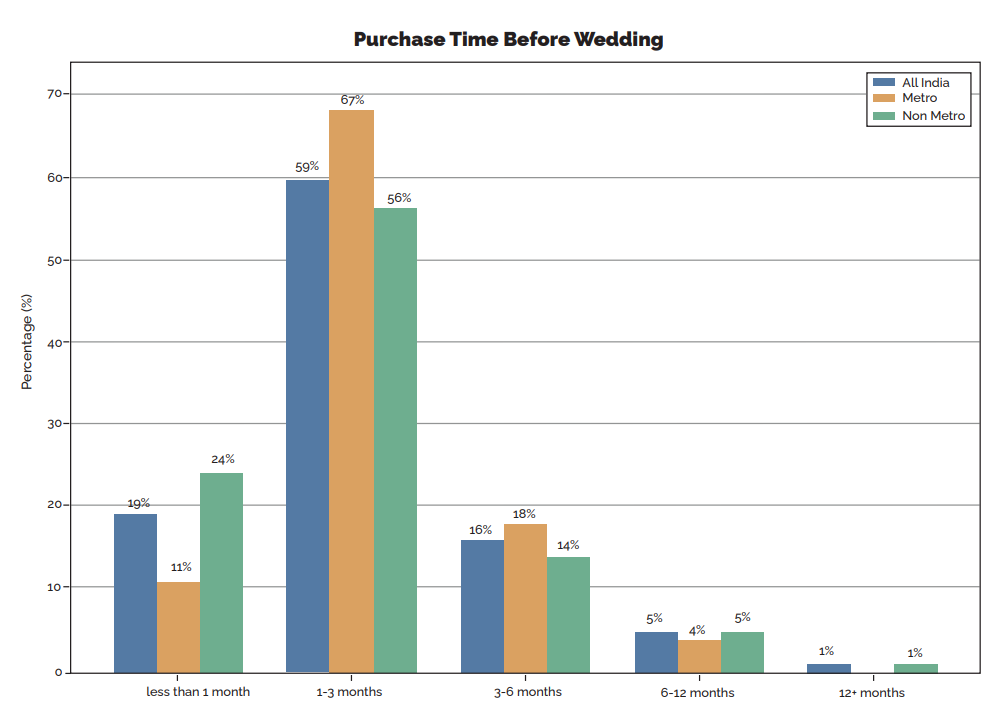
Purchase Timing
How soon before the wedding are brides finalising their purchase?
Key Findings:
- – 78% of retailers report that brides close the final transaction within 3 months before the wedding.
- – 19% retailers report brides close the transaction in the final month — a significant last-minute cohort presenting fulfilment challenges.
- – Only 5% plan 6+ months ahead. The long-lead buyer is rare.
Analysis and Action Points:
The purchase timing data may systematically underestimate the length of the bridal relationship. The real decision window opens earlier — rate lock, monthly savings, design search and comparative study etc. This is a critical insight for how retailers should measure their customer journey and where they should invest in relationship-building activities.
- – Amplified marketing in the last 3-month window: Retargeting campaigns, personalised WhatsApp follow-ups, and limited-time offers on bridal scheme enrollment should all be calibrated to land within 90 days of a typical wedding date. Know your local wedding season calendar and plan backwards from it.
- – Enhance rate lock and systematic savings by offering higher incentives for bridal purchases: Bundle packages with services and extra benefits to create a true acquisition event. When a bride enrolls in your bridal schemes, she becomes your customer even if the transaction occurs months later. Focus on nurturing the relationship between rate lock and the final sale through design consultations, preview events, and customisation discussions to make the journey memorable.
Key Factor at the Final Decision Stage
Which single factor most influences the bride at the final purchase decision apart from price?
Key Findings:
- – Design leads at 47%. Collectively, Design + Value for Money + Brand Trust = 93% of all responses. These three factors are the foundation of the bride’s final decision-making. Brand Trust is rated marginally higher in metros, while value for money is rated marginally higher in Non-Metros.
Analysis and Action Points:
Design has emerged as the top individual factor, led by the zoomers’ need for jewellery style that defines their individuality and their growing authority over the final decision. However, design does not operate alone. Trust, Accountability, and Value are not secondary factors that lose out to design; they are prerequisites that earn the retailer the right to show the bride their designs. Without trust, brides do not come. Without value, brides do not stay. Design is what closes the deal.
- – New entrants, Lead with trust signals, then designs: The implication for new market entrants is particularly sharp; you cannot win through design alone. The retailer who enters a new market with a beautiful product must have a trust-building framework.
- – Build Design Authority
- > Market theme-based design collections: Periodically introduce at least one collection that is marketed purely on its creation story. Centre the entire marketing effort on the processes of ideation, development, and final manufacturing. Assembling such a collection reveals the jeweller’s design expertise.
- > Customer testimonies on design excellence: Let the brides vouch for the designs.
- > Engage the customers into design conversations: Co-create collections, letting the designer engage customers through their creative process and the designs’ backstory.
- > Nurture upcoming designers: Pop-ups showcasing their work build an image as a forward-thinking (investing in design innovation) and authentic brand (supporting design talent), while making the retail space more exploratory for young customers.
- > Create award worthy designs: Winning accolades for designs on national platforms is surely great marketing material. External and reputable validation builds curiosity (among new customers) and pride (among existing customers).
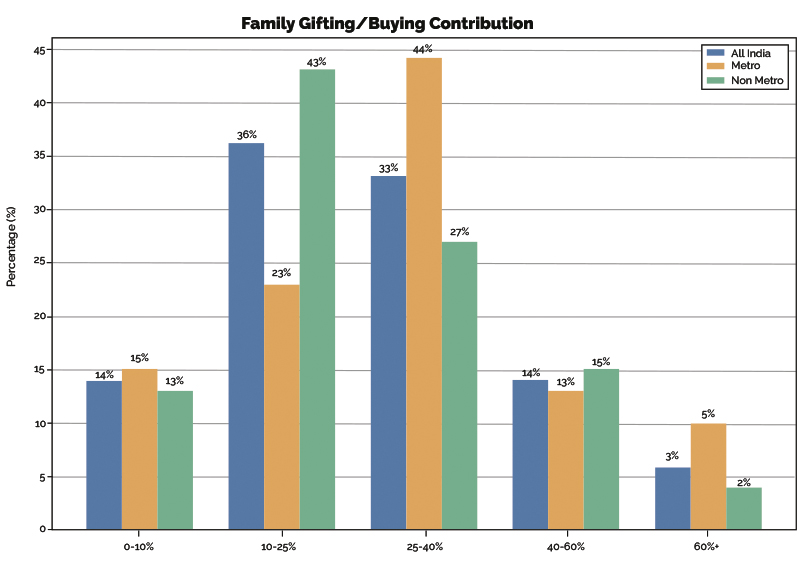
Family Bridal Purchases
What percentage of overall jewellery business comes from purchases by the bride’s and/or groom’s families?
Key Findings:
- – 83% of retailers report that less than 40% of their business comes from family purchases, even though a captive segment, for the majority, it is still not a large contributor.
Analysis and Action Points:
There is a strong opportunity to target this captive cohort within the bridal segment. Retailers can devise campaigns that directly communicate with them, emphasising the importance and desirability of the purchase for this once in a lifetime occasion.
- – Exclusive jewellery remodelling service for the family: ‘Old to New — Jewellery Transformed for Bridal Celebrations’, tailored for the bride and groom’s families. It offers options to redesign, restore, or reimagine heirloom pieces. This service generates a new high-margin revenue stream, attracts families to the store, and fosters a trusted-adviser relationship — creating the strongest competitive advantage in the industry.
- – Gift an heirloom bridal trousseau: A premium service that preserves ‘Emotional history’ in ‘Bride’s personal style’. Positioned as a treasured family gift for the bride, in addition to new purchases. Think of a well-designed, branded trunk that represents heritage, new beginnings, and memories.
- – Wedding-Family Buying Scheme: Offer tiered benefits for multiple purchases to encourage family shopping at a single store.
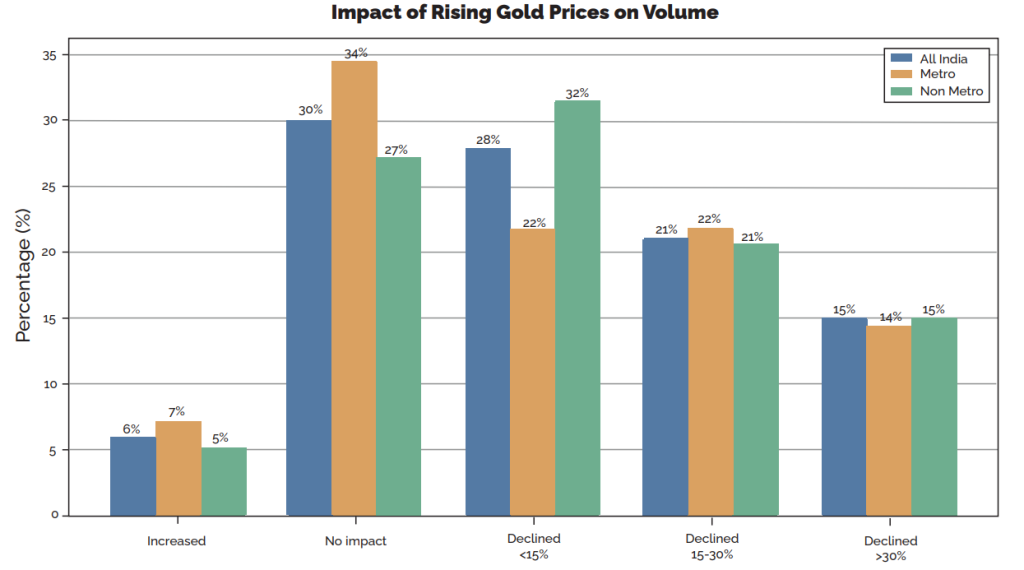
Impact of Rising Gold Prices on Volume
How did rising gold price affect bridal volumes in 2025?
Key Findings:
- – 64% of retailers nationally report volume decline due to rising gold prices. The decline cohort is similarly distributed across metro and non-metro, suggesting the severe end of the impact is equally distributed.
- – Notably, 6% of retailers report volume increases despite rising prices — the most instructive cohort in this question, where rising gold rates translate to higher aspiration value rather than deterrence.
- – Nearly 1/3rd report no impact on sales due to price rise.
Metro vs. Non-Metro:
- – 58% Metro vs 68% Non-Metro jewellers show volume decline due to gold price rise.
- – 34% Metro vs 27% Non-Metro jewellers report no impact due to the price rise.
Metro jewellers report higher resilience, with fewer reporting volume declines and more reporting no impact due to the price rise, compared to non-metros.
Analysis and Action Points:
A large part of the surveyed market has been affected by the rise in gold prices, while a segment remains unaffected and continues to grow. This is the premium paradox: what compresses volume at the mass-market also amplifies aspiration at the high end.
- – Study ‘no impact’ customers: Understanding the income profile and decision-making pattern of your price-inelastic customers will help you identify and acquire more of them.
- – Consider ‘Making charges holiday’ for peak bridal season: Even a temporary fixed-making-charge (delinked to the rising value of gold) promotion might address the primary anxiety of budget-conscious buyers. Measure the margin impact and run it for one season to see how much conversion improves.
Inflating Making Charges
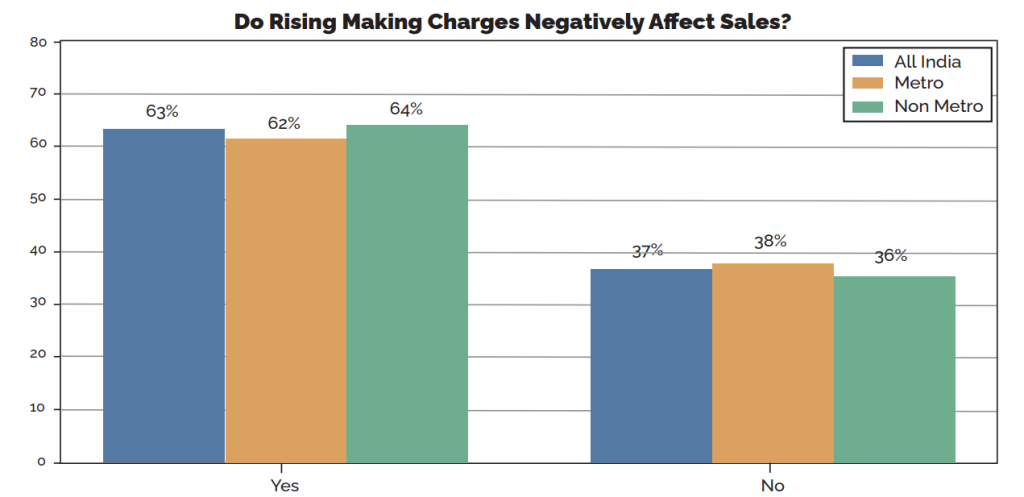
Do rising making charges linked to gold price negatively affect sales?
Key Findings:
- – 63% jewellers confirm rising making charges are negatively impacting sales.
- – The making charge impact is near uniform across Metro (62%) and Non-Metro (64%).
Analysis and Action Points:
The near universality of the negative impact of making charges is the defining finding of this question. It shows that this is a structural, industry-wide challenge, not a segment-specific one. It confirms that the making charge model (calculated as a percentage of gold value) has become structurally misaligned with market reality due to high gold prices.
- – Pilot fixed making charges: The retailer who finds a way to break this linkage through flat making charges creates an immediate competitive advantage. Experiment on a specific product line or for a limited booking window. Measure conversion rates for fixed charges vs the standard making charge model. If the conversion rate increases and justifies the margin adjustment, make it a permanent feature of the premium bridal offering.
Future Gold Volume Outlook
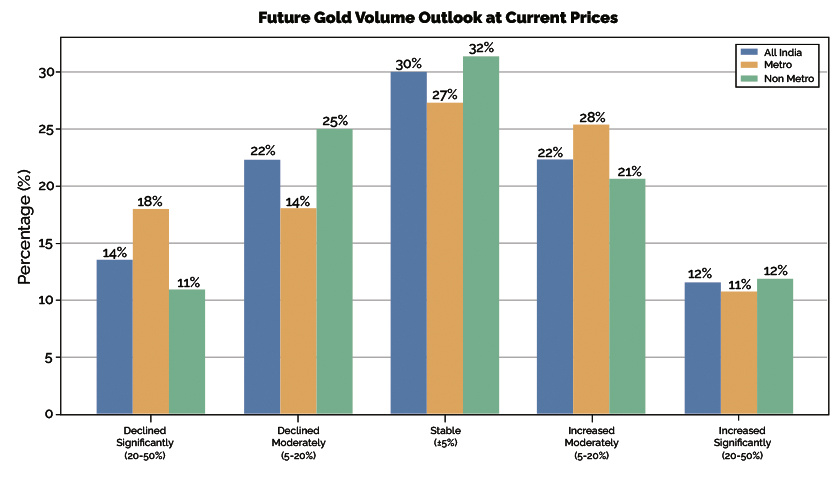
If gold stays at current levels, what happens to bridal gold purchase volumes?
Key Findings:
- – The market is divided almost equally into three camps: 30% expect stability, 36% expect further decline, and 34% expect volumes to increase.
- – This is the most divided opinion of any question in the survey, signalling genuine market uncertainty about how consumer behaviour will evolve under sustained high gold prices.
NOTE: Survey responses were gathered over a two-week period in February 2026. The gold price during the survey period averaged Rs. 14,800 per gram for 24K.
Analysis and Action Points:
The near-equal three-way split is not indecision, but genuine structural complexity. The optimists are betting on consumer adaptation: the market absorbs the new gold price as wedding culture remains strong, and budgets adjust over time, while a new segment of premium clients see more value and increases spends. The pessimists are betting on structural erosion: as gold prices outpace the growth in per-capita income, middle-class families who were the backbone of volume gold sales reduce quantity. Both are happening simultaneously in different market segments. The sophisticated retailer is not betting on one outcome, they are building a product and pricing portfolio that performs across both scenarios.
- – Build a portfolio resilience strategy: Develop a product portfolio that caters to customers across the entire price spectrum. Incorporate premium designs and storytelling for high-end products, while offering lighter, more affordable options for budget-conscious consumers.
- – Promote comparative choices: Establish a price-point range across various categories to offer value for budget-conscious customers. Curate an affordable selection of gold, diamond, and polka sets to help customers assess the value of their purchase.
Digital Discovery
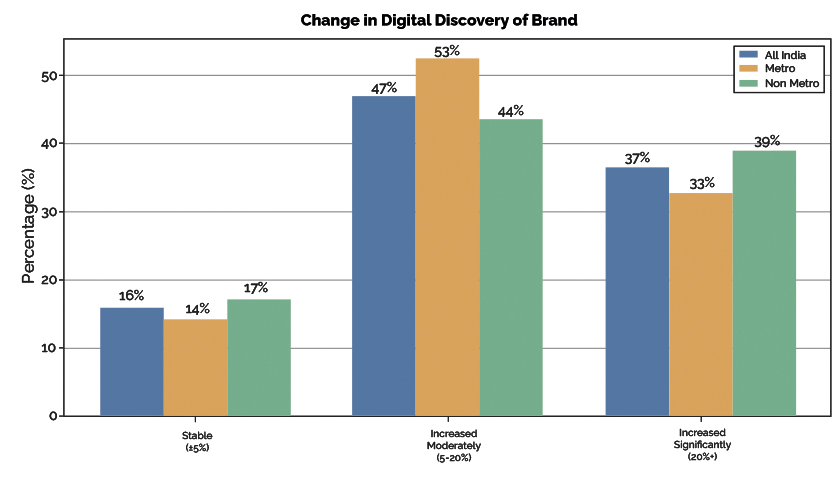
Has the percentage of brides who discover your brand digitally increased?
Key Findings:
- – 84% of all jewellers confirm digital discovery of their brand is increasing — 37% significantly and 47% moderately.
Metro vs. Non-Metro:
- – 33% Metros vs 39% Non-Metro jewellers report significant digital discovery growth (20%+ brides).
Digital is no longer a metro phenomenon; it is a great equaliser for non-metros. The discovery-led growth in the bridal space is higher in non-metros.
Analysis and Action Points:
Digital discovery is peaking among younger generations and has become a business imperative for survival. The challenge for independent jewellers is not whether to invest in digital, but how to be distinctive enough to win consideration in an increasingly crowded space. A bride may be willing to travel outside their traditional geographic catchment if the brand narrative is compelling.
- – Close the discovery gap: Spending on digital channels without sufficient online inventory is a missed opportunity. If a product isn’t listed online, most potential buyers won’t see it during their digital search. Hidden inventory leads to wasted capital, lost sales, and a weaker omnichannel experience. Building a well-organised online bridal gallery can help maximize digital returns.
- – Build brand stickiness at the discovery stage: As most Zoomers research products online, jewellers must differentiate themselves at this early phase.
- > Potential brides must be emotionally engaged through relevant communication.
- > Introduce regular bridal design drops, educational blogs, style guides, and exclusive offers.
- > Build an online bridal community. Incentivize brides to join it with greater benefits — exclusive invites to in-store events, vouchers for spa, beauty or apparel. Brides should be engaged with top-tier designs, pre-appointment support, personalised follow-up, and additional incentives to finally end the discovery journey at the store
- – Track funnel: Track how many digital enquiries result in in-store appointments, and how many of those result in purchases. Measure digital-to-transaction conversion. Check if there is a funnel problem.
Generational Families (Loyalty)
How has the contribution of generational bridal families changed in your business over the past year?
Key Findings:
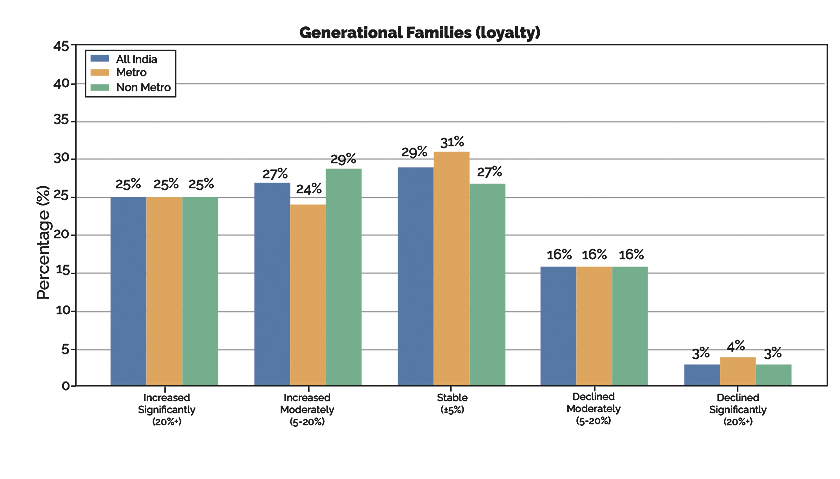
- – 52% of retailers report that the contribution of repeat or generational bridal families to their business has increased.
- – Only 19% report a decline in contribution.
- – The near-uniformity in metro vs non-metro underscores the trust-intensive nature of bridal purchases.
This data must be read specifically within the bridal context — not everyday jewellery. Bridal transactions are high-value, emotionally significant, and infrequent. When a family returns for another wedding, it represents not just retention, but inter-generational continuity in revenue contribution.
Analysis and Action Points:
Despite rising digital discovery, over half of retailers report that the contribution from repeat or generational bridal families is increasing. The paradox resolves when we separate discovery from decision.
Brides may discover widely through digital platforms and peer networks, but the final transaction, especially in bridal, have the high possibilities of returning to the trusted family jeweller.
Non-metros show marginally tighter bonds because the family jeweller carries social capital. In effect, as discovery expands, digital investment must be paired with aggressive trust-building strategies and legacy communication to capture both new entrants and repeat family pipelines.
- – Build a structured generational tracking system: Maintain a database of the family members. These are predictable revenue cycles.
- – Keep emotional bridge intact across generations: Invite mothers and daughters for styling previews or heirloom redesign consultations.
- – Exclusive benefits for generational bridal families: Extra loyalty tiers, early previews, priority service, and exclusive designs. Make repeat business feel rewarded.
Pre-Bridal Marketing
Do you actively target younger, pre-bridal customers beyond advertising collections?
Key Findings:
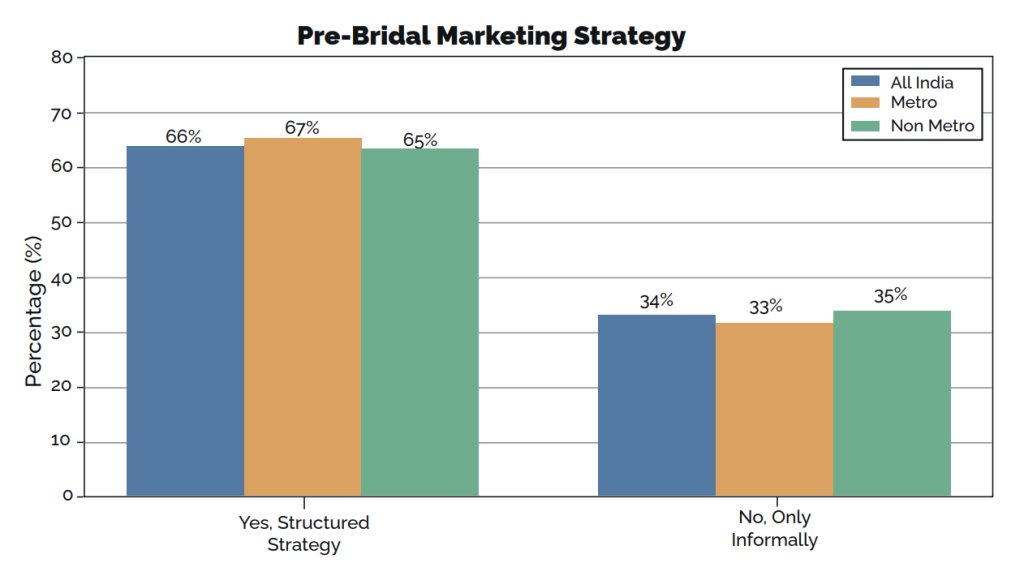
- – 66% of retailers have a structured pre-bridal marketing strategy. This is now a mainstream practice.
Analysis and Action Points:
More retailers are beginning to value the compounding loyalty that comes from winning a customer before she is ready to buy bridal jewellery. The industry acknowledges that the loyalty battle must be won years before the wedding.
- – Target youth on the pathway to employment: Incentivised Gold Saving program for youth joining the workforce. Position gold not just as jewellery, but as a growing financial foundation. Create long term investment schemes with high-yield redemption schemes linked to marriage funds.
- – Pre-bridal initiatives: A quarterly ‘Youth Jewellery Styling Masterclass’, a series of educational sessions ‘Young Women’s Jewellery Guide’.
- – Build recruiter brands: Launch sub-brands offering low-value-high-style entry point jewellery that attract young customers and nurture relationships as they develop.
Bridal Conversion
What enables the highest conversion in bridal sales?
Key Findings:
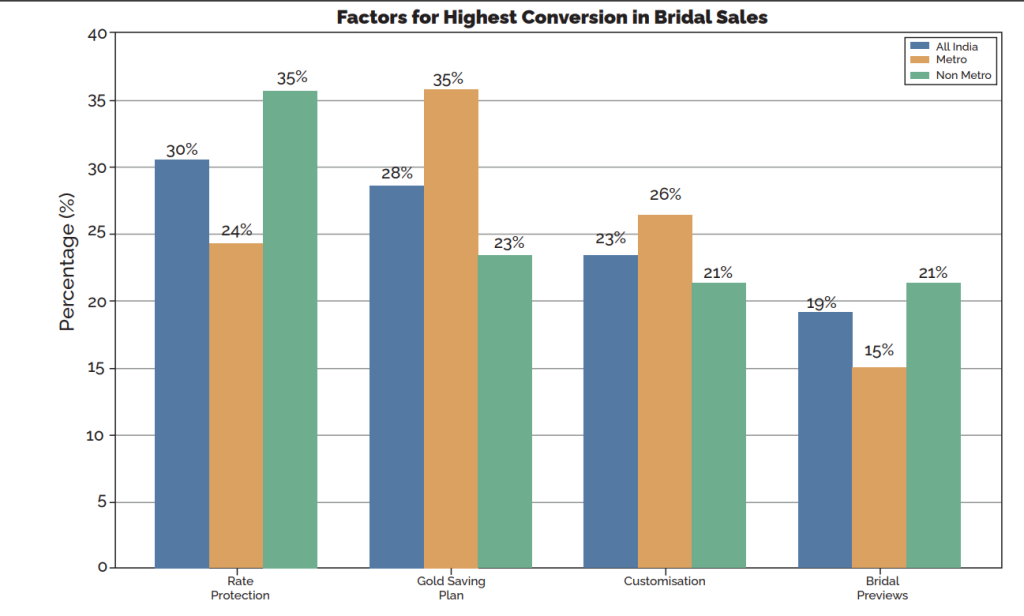
- – Overall Rate Protection scheme tops the charts.
- – 58% of retailers report rate protection and gold savings as the two topmost effective schemes. Bridal collection previews — in person events — work significantly better in Non-Metros (21%) as compared to Metros (15%).
Metro vs. Non-Metro:
- – 24% Metro vs 35% Non-Metro jewellers report rate protection as the most impactful factor in bridal conversion.
- – 35% Metro vs 23% Non-Metro jewellers report gold savings as an effective scheme.
The data reveals a fundamental difference in what drives bridal commitment across market types. In metro, gold savings plans align with metro families’ systematic financial planning habits. In non-metros, rate protection dominates as consumers are less willing to take price risk.
Analysis and Action Points:
Customers who are locked in through annual and ongoing schemes are far more likely to close the bridal transaction with the same jeweller.
- – Exclusive Rate Protection Plan for brides: A lead product, not a fine print benefit: Make it a transparent, prominently communicated offer, not a generic supplementary scheme extended to all others. It can become a powerful, rational reason to commit early in the decision journey.
- – Create a Marriage Fund: Structure a pre-bridal gold savings plan that differs from monthly schemes. Additionally, offer a high-yield redemption plan complemented by a range of benefits leading up to the final transaction.
- – Personalised invites, curated shows: Conceptualise price-based bridal curations. Develop previews themed around bridal occasions where decor and jewellery harmoniously complement each other, whether for cocktails, sangeet, or the wedding day. Craft Instagram-worthy, shareable moments for Zoomers to post and remember the experience.
Marketing Impact
What are your current focus areas for marketing the category to potential brides?
Key Findings:
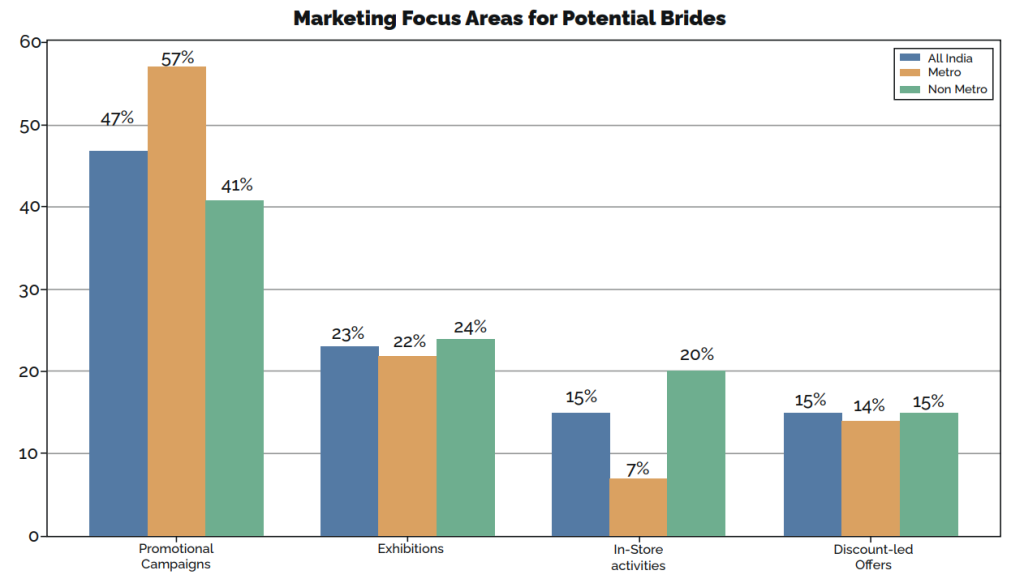
Promotional campaigns dominate nationally at 47%. Though exhibitions are more effective than discounts, individually they are uniformly effective across Metros and Non-Metros. In-store activities: 7% Metro vs 20% Non-Metro — a 3x gap in metros is one of the most actionable findings in the survey.
Metro vs. Non-Metro:
- – In Metros: Promotional campaigns (57%) vs in-store activities (7%).
- – In Non-Metros: Promotional campaigns (41%) vs in-store activities (20%). The gap in metro coverage is concerning.
Non-metro’s more balanced mix reflects the community-driven nature of smaller-city retail. As digital discovery grows, in-person events become increasingly important for a highly personal, carefully considered category. With brands vying for attention in the digital space, hosting physical store events will serve as a key differentiator.
Analysis and Action Points:
The survey does not differentiate between digital and traditional promotional campaigns, as augmenting traditional promotions with digital components is now essential. However, the overemphasis on promotions masks the importance of the physical-experiential channel, which could significantly improve the digital-to-transaction conversion rate.
- – Separate non-experiential from experiential budgets: Break down your marketing budget. Moving a small portion from digital reach to in-store experiences can foster emotional bonds and generate word-of-mouth that digital advertising cannot match, significantly boosting transaction conversion rates.
- – Transform the store into an exclusive club: Demonstrations of craftsmanship, talks by women achievers, tasting sessions by famous chefs or popular restaurants. Make it a social hub for the potential bridal community.
Groom Jewellery Demand Trend
How has demand for groom jewellery changed in the last 3 years?
Key Findings:
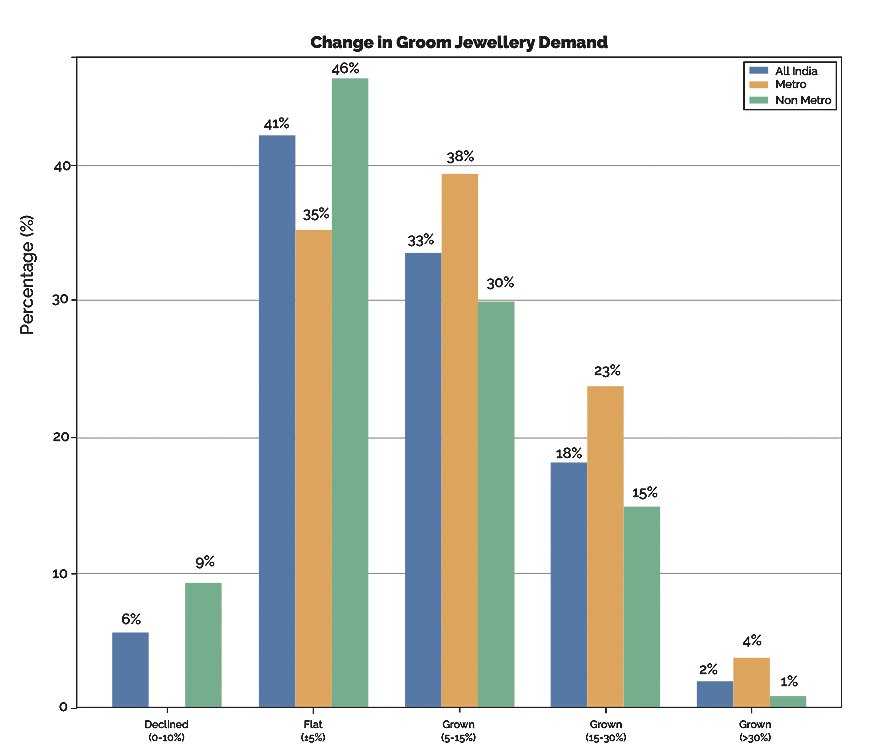
- – 94% of the market is stable or growing for groom jewellery — the trajectory is clear.
- – 53% of retailers report growing groom jewellery demand; 33% moderately (5%-15%) and 20% significantly (15-30%+).
- – The growth above 30% is reported by only 2% — indicating significant untapped upside for retailers who invest in this category.
Metro vs. Non-Metro:
- – 65% Metro vs 46% Non-Metro jewellers report a growing demand.
- – 0% Metro vs 9% Non-Metro jewellers report decline.
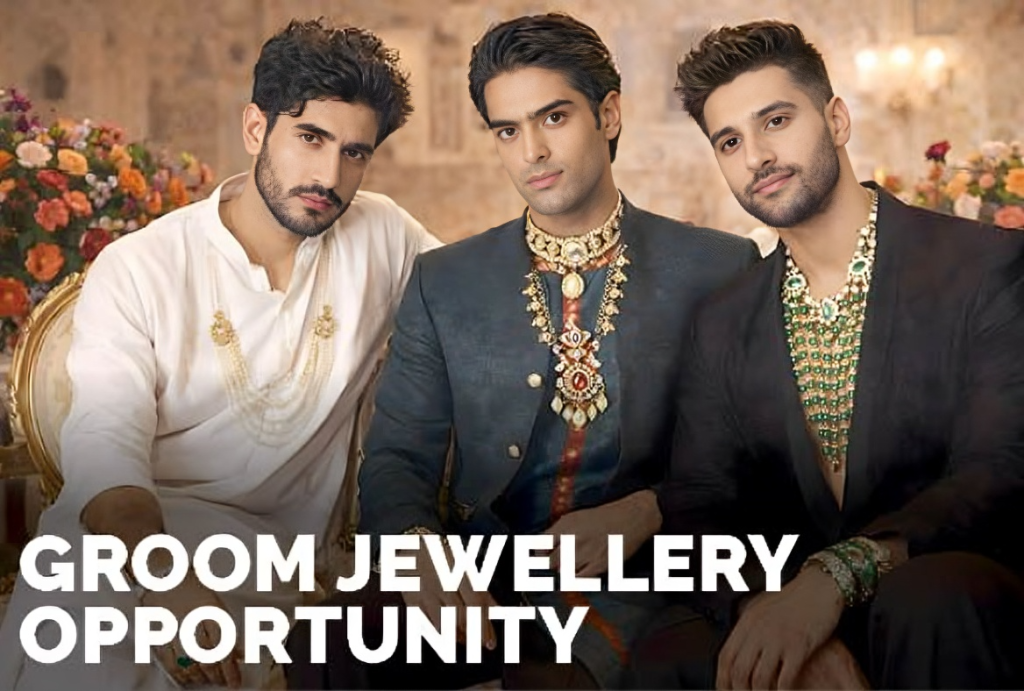
The metro groom market follows a one-way growth path. The opportunity for non-metro areas is to introduce the fashion-groom conversation to buyers who have traditionally considered only gold chains and rings.
Analysis and Action Points:
India’s men’s fashion market is the structural tailwind behind groom jewellery. India’s premium menswear and ethnic fashion market has been growing driven by social media, the rise of men’s lifestyle influencer culture, and the ‘groomzilla’.
- – A dedicated Groom’s Corner: A small, dedicated display — curated product, a look book, clear pricing signals that gives importance to the grooms. A dedicated visible space and a sales narrative for groom jewellery creates immediate category differentiation.
- – Build a Groom’s Styling Guide: In store and on Instagram. A ‘guide to groom jewellery by outfit and budget’ reduces the awkwardness of the male buying conversation, normalises premium groom spending, and positions the store as an authority in a category where no one else is yet speaking with confidence.
- – Adapt winning bridal ideas: Many of the ideas for experiential in-store moments tailored for brides can also be adapted to create a better experience for the groom.
Average Groom Jewellery Spend
What is the average spend on groom jewellery?
Key Findings:
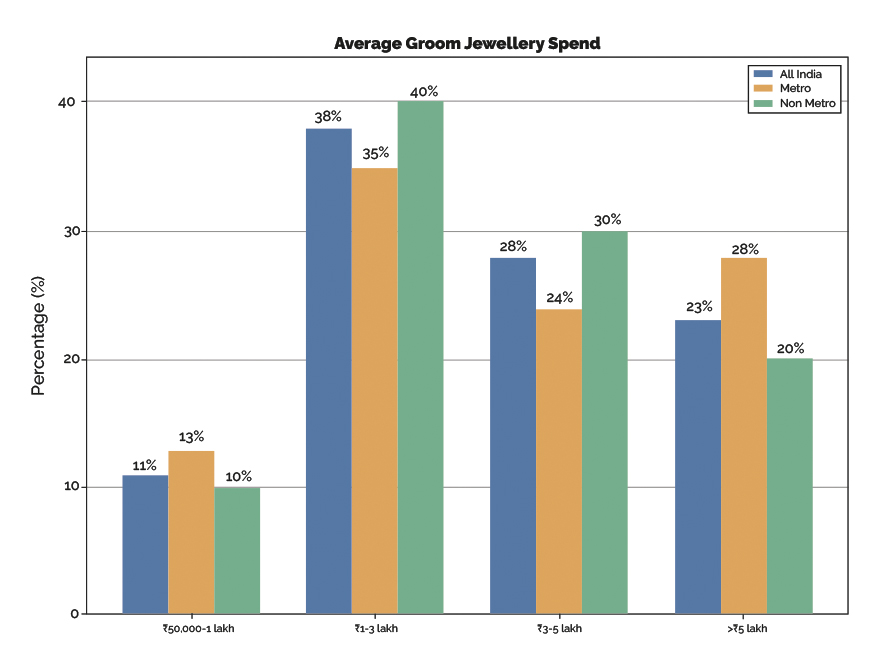
- – 66% of retailers report average groom spend in the Rs. 1-5 lakh range.
- – Only 11% report less than Rs. 1 lakh spends — budget groom buyers are the minority.
- – Non-metro shows higher concentration in the Rs. 1-5 lakh bands (70%), confirming a robust mid-market groom consumer base in smaller cities.
Metro vs. Non-Metro:
- – 59% Metro vs 70% Non-Metro jewellers report average spend of 1-5 lakhs.
- – 28% Metro vs 20% Non-Metro report average spend of over 5 lakh.
Metro skews premium. The average non-metro groom is not a budget buyer. He is spending meaningfully, just in the mid-market range. This is a strong foundation for upselling into higher categories as the fashion conversation develops.
Groom Purchase Categories
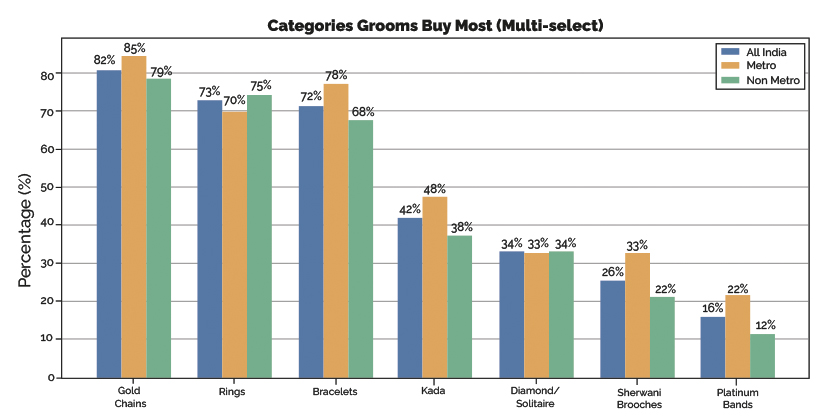
Which categories do grooms buy most?
Key Findings:
- – Gold chains (82%), Rings (73%), and Bracelets (72%) — the traditional trio dominates nationally.
- – Diamond solitaire pieces are the emerging category at 34%. Sherwani brooches (26%) are establishing as an occasion-specific category.
- – Platinum bands: 22% in Metro vs. only 12% in Non-Metro — the fashion-premium groom is a Metro phenomenon so far.
Analysis and Action Points:
Metro grooms show a fashion-forward basket: The Metro groom is assembling a complete wedding style statement — jewellery as part of a curated outfit, not just a cultural obligation. Non-metro groom purchases are traditional. Non-metro has more people reporting momentum in traditional categories — chains, rings, bracelets. The opportunity here is introducing the fashion accessory conversation, Sherwani brooches, Platinum bands to a buyer who hasn’t yet been invited into that territory by his jeweller.
- – Train your team for the groom upsell: The Gold Chain + Ring buyer is your baseline entry. A trained salesperson who can naturally introduce ‘this Sherwani brooch is very popular with grooms in this budget range’ or ‘have you thought about a Platinum band as your wedding ring?’ may lift average groom basket by 20-30% with no additional acquisition cost.
- – Promote New looks: Develop new fashionable styles for various bridal occasions to inspire the aspirations of potential grooms.
Expected Business Growth FY 2026-27
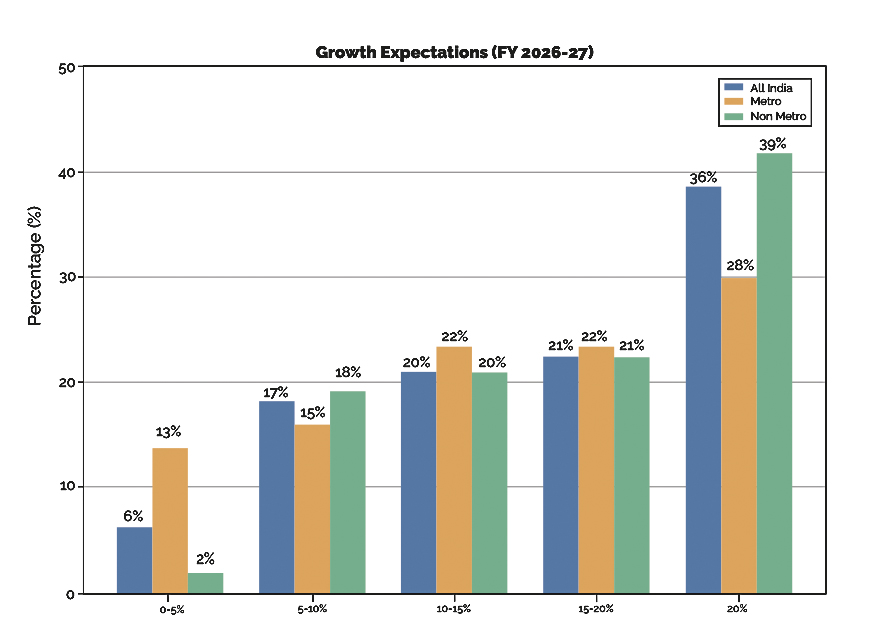
How much do you expect your bridal jewellery business to grow in FY 2026-27?
Key Findings:
- – 77% of retailers expect double-digit growth (10%+) in FY 2026-27.
- – Only 6% are flat or uncertain — near-unanimous optimism.
Metro vs. Non-Metro:
- – 13% Metro vs 2% Non-Metro jewellers report flat or uncertain growth.
- – 28% Metro vs 39% Non-Metro jewellers expect 20%+ growth.
Non-metros are more bullish than metros. Metro independents are operating in markets where demand is growing, but competitive pressure is intensifying. The retailer who is uncertain in a market with strong macro tailwinds is signalling a strategy problem, not a demand problem. The confidence in non-metros is indicative of growing incomes, first-generation premium buyers, lower competitive pressure, and digital discovery acceleration that is expanding reach.
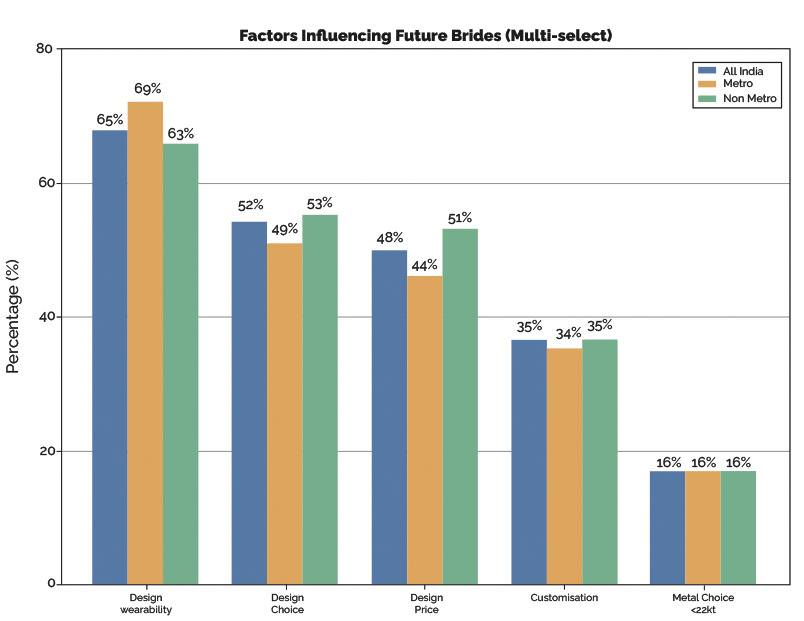
Future Factors Influencing Bride’s Buying Decision
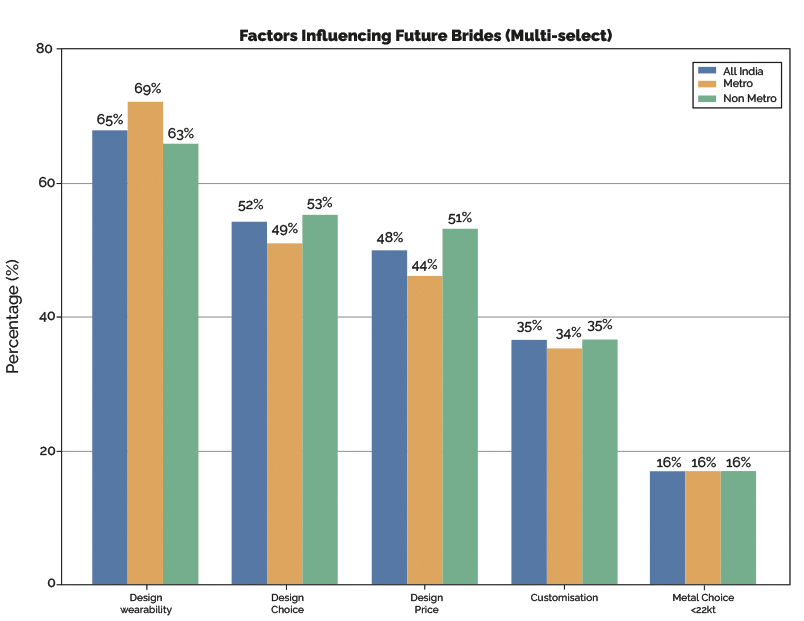
Which factors will most influence the buying decision of brides in the future? (Select top 3)
Key Findings:
- – Overall, design is the hero. Wearability of the Design (post-occasion utility) leads at 65%.
- – Design Variety (Choice and aesthetics) follows at 52%.
Analysis and Action Points:
Wearability of the Design represents the most significant structural shift in India’s bridal jewellery culture. The transition from ‘jewellery as ritual object and investment’ to ‘jewellery as versatile accessory’ is redefining what brides look for and what retailers need to stock.
The sub-22Kt metal experimentation in the bridal space is a subtle but important signal. The cultural emphasis on 22Kt purity acts as a structural constraint that should be gradually challenged. Jewellers who create 18kt bridal offerings with a clear design rationale will be positioned ahead of the next major product shift.
- – Invest in design modularity: Every elaborate set should include ‘post-wedding wearable’ versions. Market it as suitable for multiple occasions. This doubles the design conversation and effectively boosts average transaction value.
- – Invest in product development: Consumers appreciate design variety — not necessarily a large inventory but unique options. Co-create with suppliers to build signature designs that promotes exclusive choices to avoid comparative shopping, especially in the digital era, where design search is easy.
- – Antique for less: Start exploring traditional designs and antique finishes in 18Kt bridal jewellery for brides. Build knowledge and a small inventory to familiarise customers with the design possibilities in lower karatage.
Methodology · Open-ended Qualitative Responses
Respondents’ open-ended comments on the “single biggest change in the bridal jewellery market” revealed five recurring themes — each pointing to a structural shift reshaping how bridal jewellery is bought, sold, and experienced across India.
The Wearability Revolution
The most frequently mentioned theme was the shift from heavy, elaborate traditional sets to lighter, versatile, and wearable jewellery. Brides increasingly want pieces they can wear beyond the wedding day — fundamentally reshaping inventory strategy.
“From locker-heavy investments to versatile wearable jewellery”. ‘Detachable bridal jewellery’ and ‘multipurpose jewellery’ are the new ask.”
The Informed, Independent Bride
Brides are arriving with a clear brief drawn from social media moodboards, Pinterest, and Instagram. This reduces time in the consideration phase but increases pressure to exactly match her vision — pushing the demand for customisation significantly higher.
“Very clear and specific on their selection and concept” — the self-researched bride has fundamentally changed the in-store dynamic.”
The Gold Price Compression
Rising gold prices have outpaced growth in per capita income, causing families to defer volume — buying fewer pieces — or shift to lighter-weight alternatives. Part-buying across multiple occasions is emerging as a widespread coping mechanism in both metro and non-metro markets.
“Earlier people would buy their entire elaborate bridal set at once. Now buying in parts.” — rising gold costs are fragmenting the bridal purchase.”
Intricacy vs. Competition
Several jewellers flagged concerning competitive dynamics. Smaller independent jewellers are feeling squeezed between rising gold costs and prompt pressure.
“Unhealthy competition in terms of making charges” is a major concern”
Experiential & Relationship Selling
Successful jewellers describe a profound shift in how they engage with bridal customers — towards trust-based consultations, personalised service models, bridal previews, and long-term relationship maintenance. The transaction is becoming a conversation. The most successful jewellers are those who have made this transition well.
“Trust-based consultations” and bridal previews — the jewellers winning in bridal are those who sell relationships, not just jewellery.
What This Means
The Strategic Implication
These five themes converge on a single truth: the Indian bridal jewellery market is in structural transition. The jeweller who wins is not the one with the most gold in the cabinet — but the one who best understands the new bride, builds relationships before the season, and curates an experience worthy of her investment.
The shift is from product-led to experience-led selling. The opportunity is immense for those willing to evolve.
Bridal Market Survey 2026 · Retail Jeweller India · www.retailjewellerindia.com
By Soma Bhatta and Maithili Patange
Retail Jeweller India Magazine