



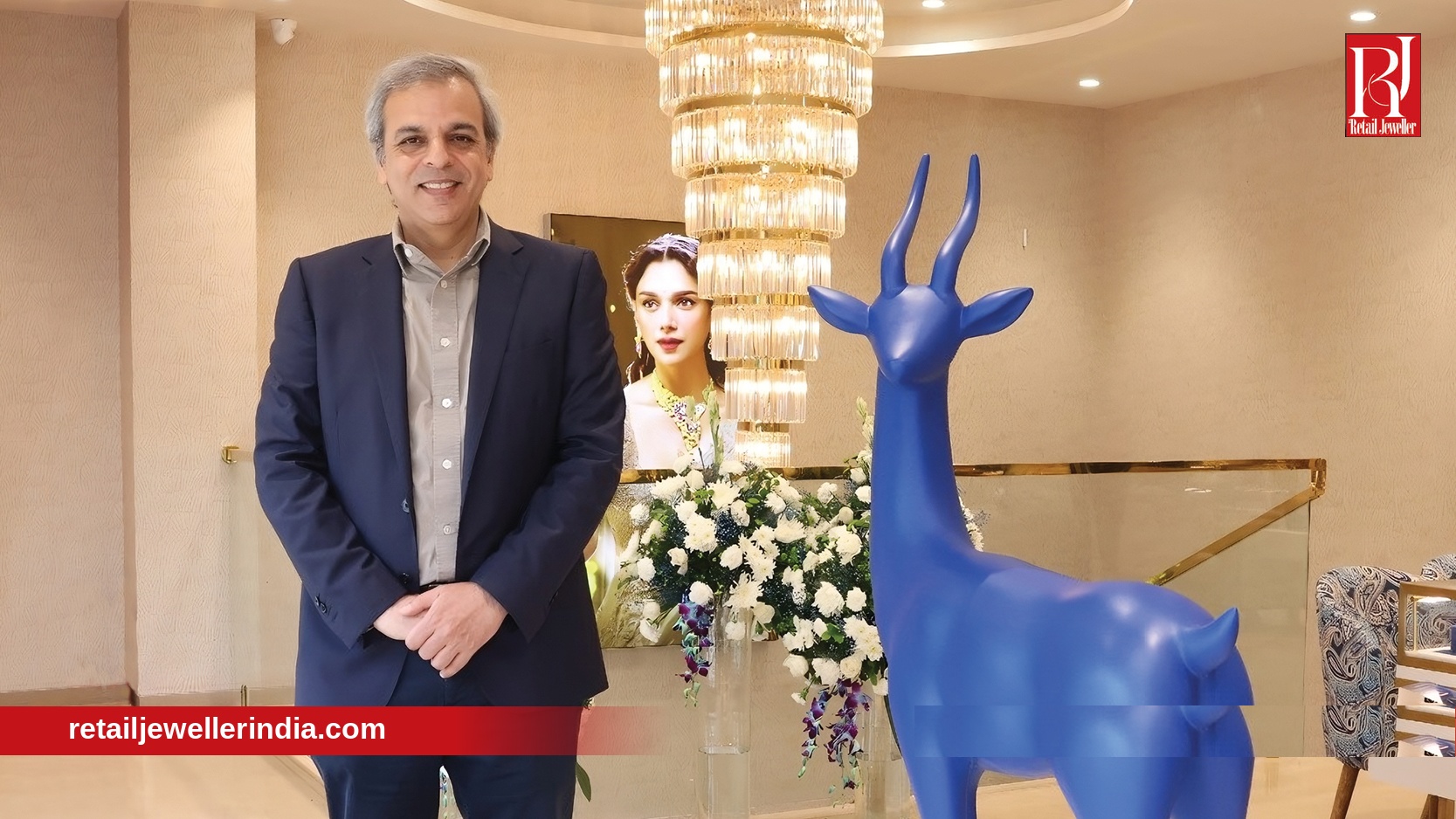

In an exclusive conversation with THE RETAIL JEWELLER, SANDEEP KOHLI, CEO of Indriya, discusses building an ecosystem that delivers the personalisation of a family jeweller with the consistency and transparency of the Birla legacy, institutionalising trust in quality beyond the 4Cs through SparkleScope, and how visual proof of sparkle is set to change how consumers buy diamonds.
MAITHILI PATANGE (MP): 80 stores in less than 24 months. Yet, you’ve resisted the standard corporate template of a “one-size-fits-all”. How do you structurally operate?
SANDEEP KOHLI (SK): I’d call Indriya a “regional brand that happens to be national.” The reality of the Indian market is that there is no singular “Indian consumer” especially when it comes to high-value buying like wedding or bridal jewellery, which dictates 60 to 65 percent of the entire market. Every community, every geography, and every catchment operates on its own distinct visual language and cultural ethos.
Our strategy from day one was to enter each market not as a distant national chain, but as a local jeweller who truly understands that catchment’s community. Our in-house design team clocks over 35,000 contemporary designs across the brand. Rather than dumping a uniform inventory across the country, we micro-target our assortments. We don’t run overarching campaigns claiming to be the brand for all Indian brides; instead, we deploy targeted narratives engineered for brides of specific regions such as Maharashtra, Rajasthan, or Telangana. We build deep regional roots, but back them with a robust, national corporate infrastructure.
MP: Indriya has recently launched a massive “Sparkle Like No Other” campaign. What is the fundamental friction point in the diamond sector that it attempts to resolve?
SK: While gold design preferences vary by geography, the underlying psychology of diamond buying is entirely universal: the consumer wants maximum chamak, or sparkle. The industry has historically hidden behind the technical mystique of the traditional ‘4Cs’ certification. While these certifications are necessary to establish paper value, they fail to communicate performance, particularly for smaller studded stones. Two diamonds can possess identical certificates for clarity and color, yet one will appear brilliant while the other looks completely dull due to light leakage from an imperfect cut. To scale our diamond business across diverse regional markets, we realized we needed a universal, scientific benchmark that instantly bridges the quality gap. That benchmark is our SparkleScope tech.
“As a new player born in the 2020s, we are using the SparkleScope to institutionalize trust instantly through transparent science. When a consumer leaves the store, they know exactly what they paid for.”
MP: Tell us more about the operational mechanics of the SparkleScope. How does it change the conversation on the showroom floor?
SK: The SparkleScope replaces diamond-buying mystique with visual proof. Back-end, gemmologists enforce a rigorous selection framework evaluating cut beyond standard metrics, accepting only one in five certified diamonds meeting strict light-return specifications. On the showroom floor, consumers look through the SparkleScope to instantly see the difference: standard diamonds reveal dark, dead zones where light escapes, while Indriya diamonds display absolute brilliance and fire.
As a new player born in the 2020s, Indriya uses the SparkleScope to institutionalize trust instantly through transparent science. When a consumer leaves, they know exactly what they paid for.
MP: You’ve noted that the Gen Z demographic is highly mobile. How does your blend of local design and standardized tech cater to this shift?
SK: This is precisely why the ‘regional but national’ matrix is so powerful. If a modern, mobile consumer buys from a strictly local player, they lose all after-sales access and service fluidity once they return to the metro where they work. By standardizing our store experiences—equipping floor staff with tablets for fully transparent, unbundled pricing, building glass-walled ‘Karigar Rooms’ for real-time gold exchange, and providing the SparkleScope for diamond evaluation—we offer absolute consistency in consumer protection and retail transparency. Yet, when that consumer walks into our Pune store versus our Delhi store, the design aesthetic feels intensely native to them.
Our strategy from day one was to enter each market not as a distant national chain, but as a local jeweller who truly understands that catchment’s community. We build deep regional roots, but we back them with a robust, national corporate infrastructure.
MP: With current gold macro-trends showing historic highs and high volatility, how is this strategy reflecting on your balance sheet?
SK: Despite high gold volatility, India’s cultural imperative to buy jewellery remains unshakeable. We see a distinct shift toward lighter jewellery with greater visual spread, alongside heightened demand for superior design variation and studded categories. Treating jewellery as personal style rather than a gold-by-weight investment keeps our average ticket values 30% to 50% higher than traditional industry benchmarks. To eliminate friction, our diamond push features an industry-first corporate guarantee: a 100% buyback and exchange value at market rates, mirroring gold’s transparency.
Ultimately, modern retail scale rejects cookie-cutter models, anchoring highly localised design sensibilities with centralised, data-driven innovations like the SparkleScope, we are building a scalable blueprint for the future of Indian jewellery retail.
By Maithili Patange
Retail Jeweller India Magazine