


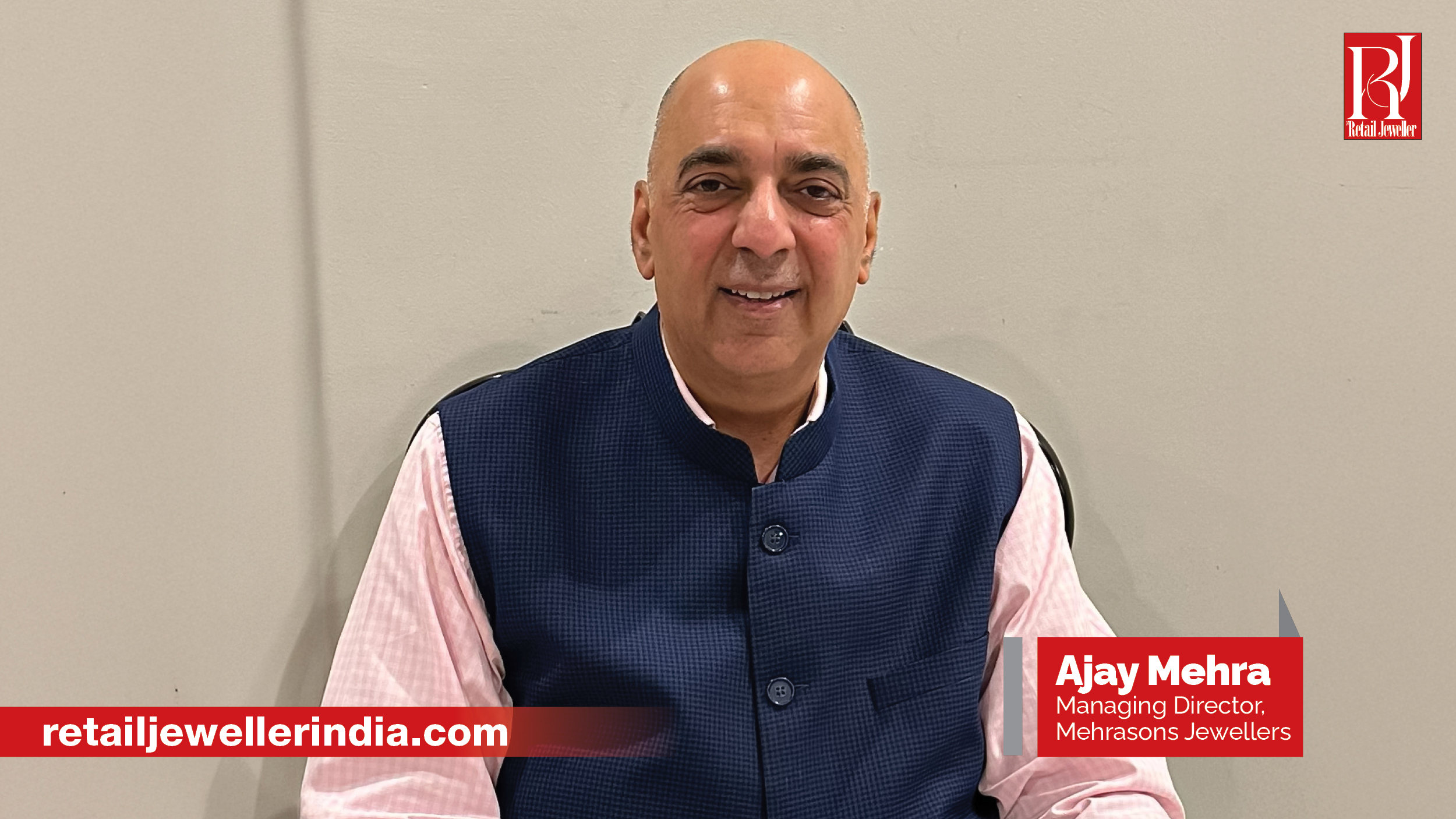

—Ajay Mehra, Managing Director, Mehrasons Jewellers
In my view, the Indian jewellery industry has, for far too long, remained focused on the visible drivers of business: gold prices, seasonal demand, expansion, branding, and design. These are important, but they are not sufficient. They often divert attention from deeper structural issues that, I believe, will ultimately define the long-term future of this industry. What concerns me is not the absence of these issues, but the limited attention we give them.
We are a significant industry by any measure, yet we continue to be treated in a fragmented manner at the policy level. Different aspects of our trade fall under multiple ministries and regulatory bodies, each addressing issues in isolation. There is no unified framework that recognises the industry as a cohesive whole. In my opinion, this lack of a holistic approach has created a misalignment between how the industry functions on the ground and how it is understood within policy.
This has led to a paradox: we are large enough to matter yet not aligned enough to influence policy in a consistent and meaningful way.
I believe one of the most persistent misconceptions affecting our industry is the treatment of gold imports, particularly in relation to the current account deficit. Gold continues to be viewed primarily through this lens which, in my opinion, is both, limiting and incorrect.
For our industry, and for the economy, gold is not a discretionary commodity: it is a primary raw material. Its import supports a wide ecosystem that includes manufacturing, employment, value addition, exports, and domestic consumption. To equate gold imports with non-essential finished goods is to overlook its productive role and its positive economic impact.
What is required is a more nuanced approach, one that distinguishes between gold used productively and gold held purely as an investment asset. Such a distinction would fundamentally alter how gold is positioned within economic discourse.
However, the challenge lies not only with policymakers, but also with us as an industry. We have not consistently challenged this narrative. At times, we have accepted simplified assumptions without adequately questioning them. In doing so, we have inadvertently reinforced a perception that does not reflect our true contribution.
Now, I want to turn to hallmarking— a necessity, but misaligned in practice
There is no ambiguity in my mind that hallmarking is essential. Consumer trust must remain non-negotiable. However, I believe the current framework raises important concerns.
The introduction of mandatory licensing for hallmarking, in my view, brings back elements of regulatory control reminiscent of the Gold Control Act. While the intent today may differ, requiring licenses to sell hallmarked jewellery risks reintroducing complexities that the industry had moved away from. It raises concerns of reverting, even partially, to a “license-driven” environment.
More critically, the issue of liability remains unresolved.
The hallmarking process involves multiple stakeholders—the jeweller, the karigar, and the Assay and Hallmarking Centre (AHC), which is responsible for testing and certifying purity. This testing is conducted through random sampling, with the assumption that sampled pieces represent the entire lot. Despite this, the law places the responsibility for any under-caratage disproportionately on the jeweller.
I find this difficult to reconcile. The jeweller does not control the testing process, nor does he determine how purity is assessed. If there are lapses in testing or deviations from prescribed standards, holding the jeweller solely accountable creates a clear imbalance between responsibility and control.
Global practices offer a more rational approach. In countries such as the United Kingdom, responsibility lies with the certifying authority: the AHC only. The principle is straightforward: accountability must rest with the entity that performs the verification.
There is also a practical concern that cannot be ignored. Several AHCs have had their licenses cancelled for failing to adhere to prescribed standards. Jewellery hallmarked by such centres continues to exist within retail inventories. If discrepancies are discovered in such cases, the question remains—who is accountable?
This lack of clarity creates both operational and legal uncertainty, and in my view, the framework requires reconsideration.
Another point I want to touch on is exports. India’s strength in jewellery lies in its craftsmanship. Our handmade products are globally respected. However, I believe our export framework does not adequately support this strength.
Procedural inefficiencies, particularly in the context of small-value shipments, and constraints on direct-to-consumer (B2C) exports limit our ability to participate fully in global markets. For instance, we are still unable to sell lightweight, high value-added jewellery directly to international customers on the international gold price due to regulatory complexities.
In an environment increasingly driven by digital commerce and flexible supply chains, these limitations are significant. There is, in my opinion, a clear disconnect between our ambition to take Indian jewellery to the world and the systems currently in place to enable that vision.
Now, I want to shift the lens inward to the need to reorient our own conversations. While policy gaps are a reality, I believe the industry must also reflect on its own approach.
We have the data, the experience, and the understanding of where the challenges lie. Yet, these issues do not consistently form part of our core discussions. Instead, we remain focused on immediate business indicators, while structural concerns receive limited attention.
In my view, this needs to change.
If the jewellery industry is to build a sustainable future, it must engage more directly with these structural questions.
In my opinion, the first step is to acknowledge the gaps we continue to overlook and to address them with clarity, consistency, and intent. Only then can we move towards a more aligned and coherent future for the industry.
The opinions and statements expressed by the individuals featured belong to them.
As told to Pratyasha K