



How Kama Built Its Business Around What Retailers Need
At a time when retailers are navigating rising input costs, faster inventory cycles, margin pressure and younger consumers who want design at accessible price points, Kama Jewellery’s three-decade journey offers a sharper way to look at manufacturing. For Kama, making jewellery has always been tied to a larger question: what will actually move at the counter?
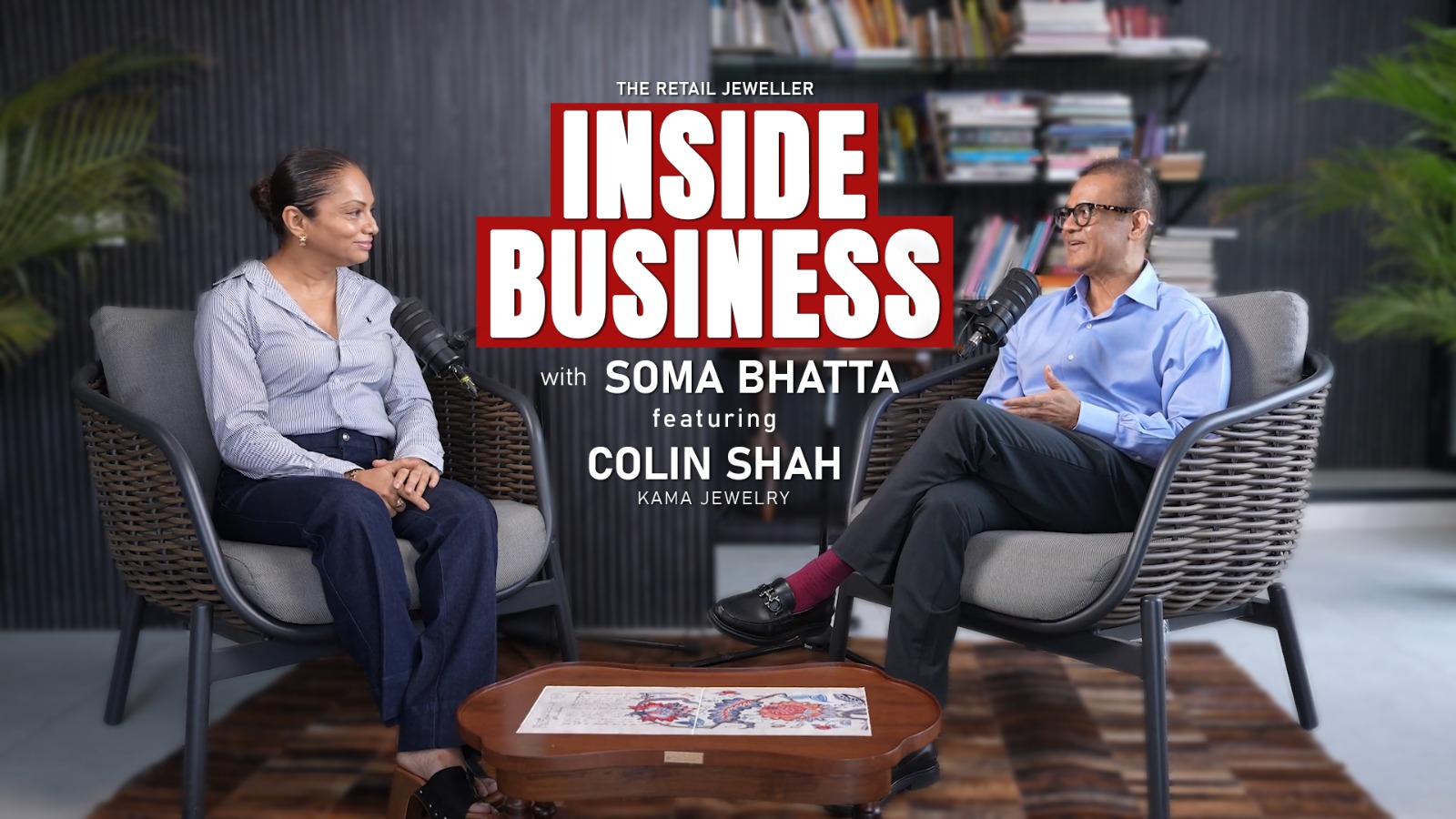
In the first interview of Inside Business with Soma Bhatta, Founder and Editor, The Retail Jeweller India, Colin Shah, Founder, Kama Jewellery, reflects on building a first-generation manufacturing company around design discipline, speed, data and retailer profitability.
Excerpts from the interview:
Q: Kama’s business has been built differently from a conventional jewellery manufacturing company. Did entering the industry as an outsider shape that approach?
A: I did not come from a jewellery family. I grew up in a family of doctors and was expected to take the same path. But after moving to commerce, I came across a diamond grading course at GJEPC, taught by Naveen Jashani, and that changed the direction of my life.
In the early years, I had no capital, no customer base and no inherited playbook for jewellery manufacturing. That forced us to think differently. Kama had to stand apart through design, quality and service. Being an outsider became an advantage because it made us build the business with discipline rather than habit. It also shaped our culture. We hire from outside the industry, train people in jewellery and bring in fresh thinking from universities, colleges and NGOs.
Q: You chose not to work on consignment. How did that constraint become a business advantage?
A: In the beginning, it was not a grand strategy. We simply did not have the capital to invest in gold and diamonds and then leave goods on consignment. But that limitation forced us to focus harder on the product.
We had to create jewellery that retailers would want to buy outright because it would sell. That meant staying away from slow-moving or risky pieces and concentrating on designs with strong sell-through. What began as a constraint became Kama’s USP: jewellery that retailers do not need on consignment because it moves.
Q: Kama is strongly associated with fast-moving, design-led jewellery. How do you define that space?
A: Kama has always focused on the $200 to $2,000 retail segment. We are not a manufacturer for one-off couture pieces. Our strength lies in differentiated, western-style jewellery that is designed to turn fast at the counter.
That category has become even more important as retailers look for accessible price points, younger consumers and faster inventory movement. We work with around 200 customers globally, collectively reaching nearly 12,000 to 15,000 retail doors, and create about 500 new designs every month. That scale is possible only when design, manufacturing and data work together.
Q: Speed is easy to claim but difficult to institutionalise. How has Kama built it into the system?
A: Over the years, we have built our internal framework using elements of Kaizen, Six Sigma and the Theory of Constraints. The larger idea is to remove waste from the system, especially the waste of time.
For our e-commerce programmes, customised rings, earrings and pendants can be dispatched in three working days, while necklaces and bracelets take around five working days. The factory works in two shifts, and we measure productivity in hours and minutes, not days. Many partners share weekly or monthly sales reports with us, and our analyst team uses that data to benchmark our collections against their average performance. Everything we do is backed by data.
Q: What will define the next phase of jewellery manufacturing and retail?
A: Retailers will have to balance aspiration with commercial viability. Consumers want better design and accessible price points, but retailers also need healthy gross margins. That is why the counter will become broader, with natural diamonds, lab-grown diamonds, gemstones, synthetics, silver, gold plating, platinum and gold all finding their place.
Technology will drive the next major shift. AI, robotics, 3D printing and virtual try-ons will alter how jewellery is designed, manufactured, presented and sold. Customisation will become more practical because retailers will be able to offer greater choice without carrying heavy inventory.
Q: After three decades, what does Kama want to be for retailers?
A: Kama is a customer-centric, profit-building partner. We bring co-created collections to retailers, help them improve profitability, and offer consumers jewellery they can aspire to season after season.
Kama’s story is ultimately not about scale alone. It is about a manufacturer that has built itself around the realities of the retail counter, from design and speed to data and sell-through. That clarity has shaped Kama’s three-decade journey and continues to define its relevance for retailers.
Click here to watch the full interview on YouTube.