

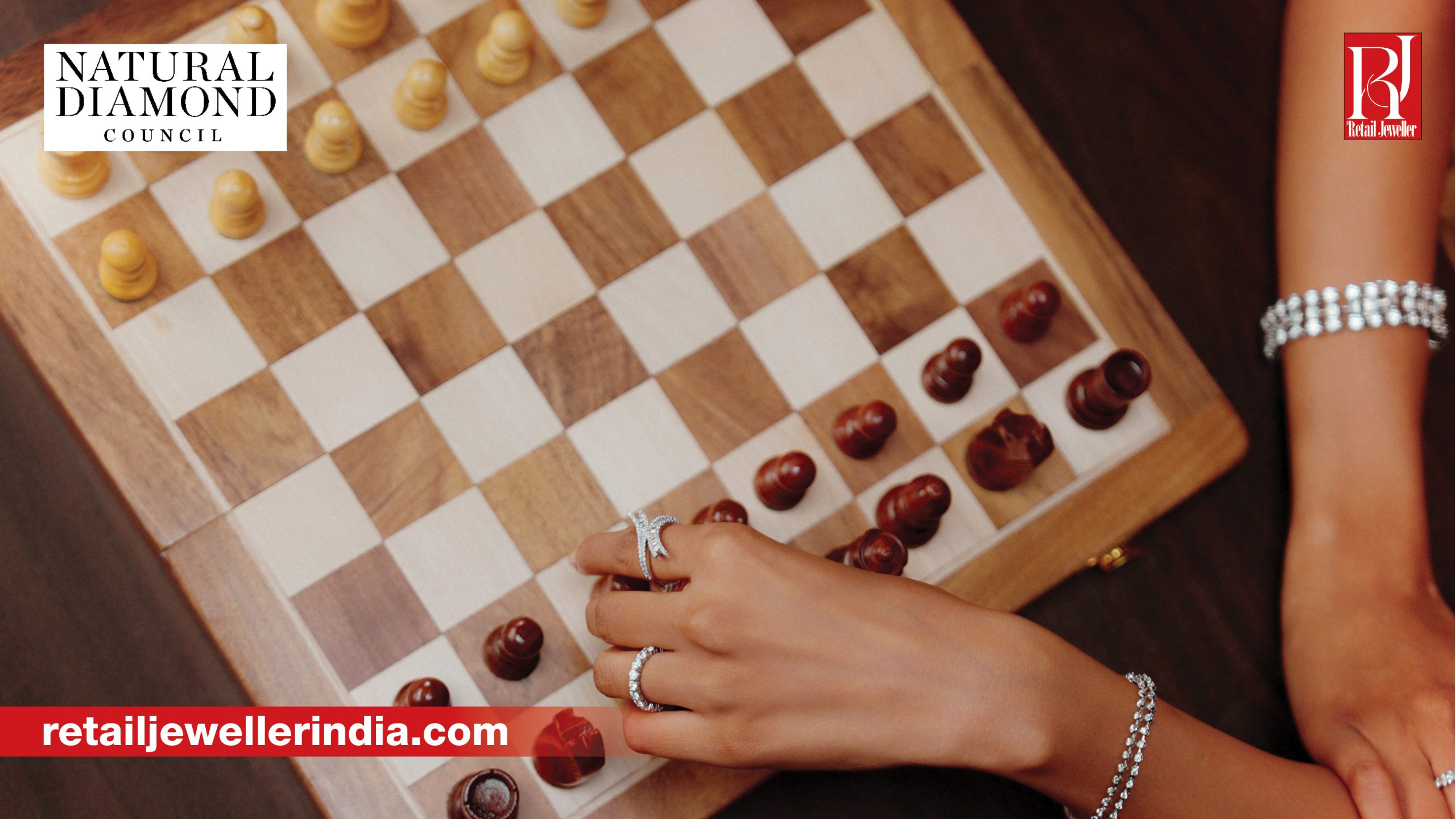

The category’s resilience is being driven significantly by younger consumers, with Gen Z and millennials now accounting for 86% of India’s total natural diamond market value
Mumbai: India’s natural diamond jewellery market continues to witness strong growth momentum, with ownership of natural diamond jewellery among Indian women increasing from 11% in 2022 to 15% in 2025, according to a recent study.
This reflects rising aspiration, accessibility and desirability for natural diamonds in India. The category’s resilience is being driven significantly by younger consumers, with Gen Z and millennials now accounting for 86% of India’s total natural diamond market value. This demographic increasingly views natural diamonds as symbols of individuality, authenticity, and emotional meaning, with consumers spending an average of Rs 1,98,000 per piece. The market is further projected to grow at a strong 12% CAGR, reaching Rs 1,520 billion by 2030. (Source – De Beers India Diamond Acquisition Study 2025)
This upward trajectory is further validated by the recent performance of leading jewellery retailers, who reported that the natural diamond category is consistently outpacing overall market growth. Saurabh Gadgil, Chairman, PNG Jewellers, for instance, recently noted that their diamond segment grew at a remarkable 61% year-on-year, significantly higher than their gold segment’s growth. Similarly, Malabar Gold & Diamonds reported a massive global sales surge during the 2026 Akshaya Tritiya period, where M.P. Ahammed, Chairman, Malabar Gold & Diamonds highlighted a 45% growth in studded jewellery specifically. These results confirm that Indian consumers are redefining the category as an essential expression of individuality and lasting value in an era of fleeting trends.
This growth comes even as the broader jewellery sector navigates macro-economic headwinds. Rajesh Rokde, Chairman of the All India Gem and Jewellery Domestic Council (GJC), recently clarified that the Government’s advisory urging citizens to temporarily pause gold purchases is a measure aimed at easing import pressures and not a reflection of any domestic supply concern. He stressed that there is no shortage of gold in the country and the domestic market remains stable.
India’s growing affinity towards diamonds is also reflected in evolving consumer preferences. A recent Deloitte study found that diamonds are second only to gold in jewellery material preference among 20-25-year-olds, with 58% of respondents in the age group choosing diamonds. This signals a significant cultural shift where natural diamonds are increasingly becoming part of everyday luxury and self-expression for younger Indian consumers.
Over the past few years, the Natural Diamond Council (NDC) has played a key role in driving these conversations and strengthening the relevance of natural diamonds among Indian consumers through education-led campaigns, cultural story-telling, regional media outreach, retailer collaborations and trend-led lifestyle narratives. From positioning natural diamonds as symbols of modern luxury and self-expression to driving conversations around authenticity, rarity and emotional value, NDC has consistently worked towards evolving the category beyond traditional occasion-led purchases.
Richa Singh, Managing Director, Natural Diamond Council says, “Diamonds have never struggled for glamour, the red carpets, the fashion moments… and we embrace all of it. But the most powerful thing about this year’s results isn’t glamorous at all, it’s a number. Natural diamond ownership among Indian women has risen from 11% to 15% in just three years. A four-point gain at national scale, in that short a window, is a clear statement of belief and one our entire trade community built together. Indian consumers are choosing the natural diamond because it is real, it is rare, and it carries emotional and heirloom value that endures long after a trend has passed. For every retailer, craftsperson and partner who helped move this market, these numbers are hard proof that the category’s growth is real, measurable, and ours to build on.”
As India’s personal disposable income is projected to grow by 11% annually, the natural diamond is uniquely positioned to remain the definitive standard for luxury. As the industry moves forward, the focus remains on maintaining a consistent annual acquisition rate and a growing consumer base that views natural diamonds as an essential, high-value asset in an evolving retail landscape.
Globally, India has emerged as the world’s second-largest diamond jewellery market. India contributes 12% of global diamond jewellery demand, up from 10% in 2019, surpassing both China and Japan.
The Natural Diamond Council is a not-for-profit organization dedicated to promoting and protecting the integrity of the natural diamond industry worldwide. Its member operations span four continents and 10 countries including Canada, South Africa and Botswana. NDC operates out of offices in New York, Shanghai, Mumbai and Antwerp, with satellite teams in the UK and France.
Retail Jeweller India News