
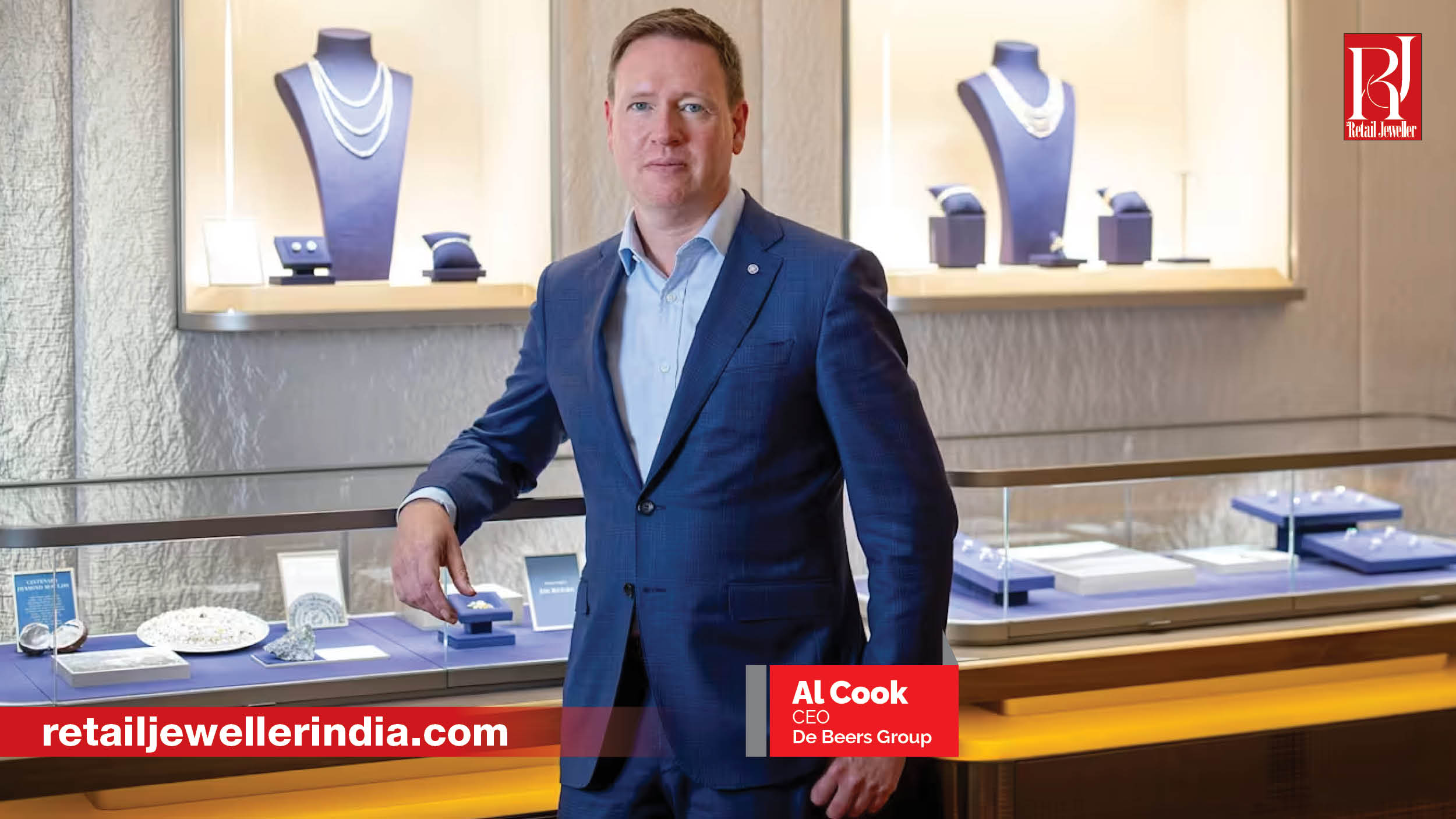

As India cements its position as the world’s second-largest market for natural diamonds, De Beers is sharpening its long-term focus on the country. In this wide-ranging conversation, Al Cook, CEO of De Beers Group, tells The Retail Jeweller why India is at the heart of De Beers’ global strategy and how the transition from ‘diamonds from India’ to ‘Diamonds for India’ signals a monumental pivot
Edited Excerpts:
Pratyasha K (PK): Welcome to India! You’ve often emphasized India as a priority for De Beers.Tell us more.
Al Cook (AC): India’s economic growth is undeniably a key factor. With a 7% GDP growth rate and the emergence of a high-income middle class, India presents a thriving market for us. In a world of unpredictable geopolitical shifts, India stands out for its economic and political stability. This stability fosters confidence, and the data speaks for itself: 2025 marks the fourth consecutive year of double-digit growth in demand for natural diamonds. In fact, preliminary estimates show an 11% year-on-year growth, making India the second-largest market globally, behind only the United States. This is particularly significant as India surpasses China in diamond demand. Nearly 90% of the world’s diamonds are cut and polished in India, largely in Surat. For a country with the longest diamond tradition, it’s an exciting transition—from ‘Diamonds from India’ to ‘Diamonds for India’, signaling a monumental pivot.
You’ve spoken about India’s growing global leadership in the diamond industry. Where do you see this leadership translating into real, on-ground impact?
I recently met with India’s Minister of Commerce and Industry, Piyush Goyal, in Delhi and congratulated him on the diamond standards announced by the Bureau of Indian Standards. These standards bring much-needed clarity at a time when there has been genuine confusion between natural diamonds and lab-grown diamonds. The standards make one thing absolutely clear: if a product is described as a diamond, it must be a natural diamond. It cannot be synthetic, lab-grown, or lab-created. Importantly, these standards positions India as a global benchmark for consumer protection in the diamond industry.
Further strengthening this leadership is India’s role in the Kimberley Process. From January 1, 2026, India has assumed the Chairpersonship of the Kimberley Process for the third time. This places India at the forefront of global efforts to prevent conflict diamonds, with a strong focus on digitalisation, traceability, and reinforcing an ethical and responsible diamond supply chain.
How do you perceive the current dynamics within the Indian diamond industry?
From a rough diamond perspective, we’ve seen decreases in price over the last three years. What matters in India is the ability to look past short-term disruptions. The long-term fundamentals remain strong: as incomes rise, diamond demand will continue to grow in India and globally.
At the same time, supply is steadily shrinking. Global diamond supply peaked in 2001 and has declined ever since. Last year was the lowest supply level since then, and 2026 is expected to be lower as mines reach the end of their life. Diamonds are no longer mined in India, Brazil, or Australia, and Canada will soon join that list. We’re fortunate to own some of the most valuable diamond mines in Botswana, which provides our business with longevity extending well beyond the middle of the century.
However, overall, diamonds are becoming rarer. We’re also seeing a clear distinction between lab-grown and natural diamonds. Today, a natural diamond costs around 20 times more than a lab-grown one. Indian consumers are highly knowledgeable about jewellery and unlikely to accept inflated lab-grown pricing, unlike some overseas markets where lab-grown diamonds still sell at very high prices.
Lab-grown diamonds will grow strongly in volume as affordable, fashionable options, while natural diamonds will continue to grow in value and demand due to their rarity and aspirational appeal. With new entrants like Titan’s Beyon entering at lower price points and no policy announcements yet, the lab-grown segment is at a particularly interesting stage.
The recent tariff dynamics have created concern across the diamond trade. How do you assess its impact?
India has led the diamond industry for over 2,500 years and has navigated many cycles of challenge and recovery. The tariff fluctuations are not favourable for India, like they were earlier. It is particularly difficult, given that around 90% of the world’s diamonds are cut and polished in India, while nearly 50% of global diamond consumption happens in the US.
In a typical year, India exports about $13 billion worth of natural diamonds, with more than a third going directly to the US and additional volumes reaching the market indirectly. As a result of the huge tariff imposition, direct exports from India to the US have dropped by roughly half.
That said, this is a short-term disruption. I am confident that India and the US will reach a more favourable trade agreement soon. We have been informed that once a deal is in place, diamond tariffs will return to zero. This gives us confidence in the future. I believe both governments will conclude a strong trade agreement in the near term. Overall, this is short-term turbulence rather than a long-term issue, and India is approaching it with a sensible, measured perspective.
De Beers expects India’s natural diamond market to double by 2030. How is De Beers actively working to accelerate that growth?
This is a very exciting phase for India, and De Beers is deeply invested here across multiple fronts. We are investing in marketing, in standards through the Institute of Diamonds, in technology through Element Six, in manufacturing of our diamond machines, and significantly in retail. Our conviction is clear: India is the right place in the world to be.
From a measurement standpoint, we closely track two things: growth in natural diamond demand and shifts in consumer perception around natural diamond jewellery. On the growth side, you will see strong marketing and promotion activity in India. This includes large-scale initiatives such as the INDRA project, sponsorship of IPL, and targeted campaigns and collections designed to create new diamond-buying occasions and experiences, including concepts like Second Piercing, Besties, and Manifestival 2026.
Most importantly, we are doubling down on retail investment. We plan to open over 100 Forevermark stores in India by 2030 through a mix of company-owned and franchise-led formats, spanning around 40 key cities across Tier 1 and Tier 2 markets. We have also recently unveiled our largest store globally in India, which is a clear symbol of our long-term commitment.
Our partnership with Tanishq is firmly established on the retail front. Beyond that, we work closely with several strong partners across India, and will continue to grow more. Also, we will announce our new set of sightholders this year. A key focus will be traceability—shifting from limited visibility to a system where every diamond is digitally tracked on a blockchain, so Indian consumers know exactly where their diamond comes from.
By Pratyasha K
The Retail Jeweller India Magazine