




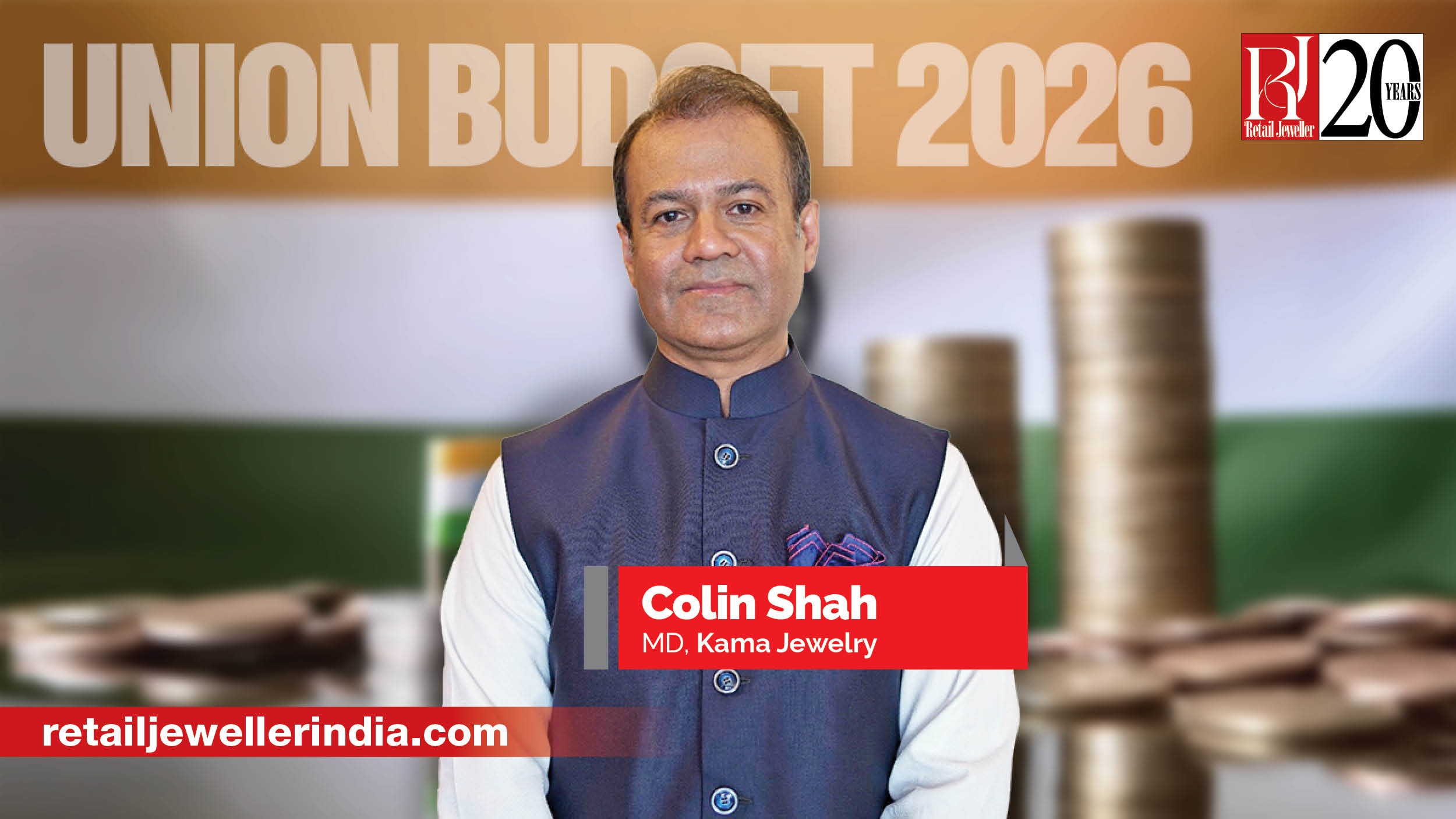

Colin Shah, MD, Kama Jewelry, says measures announced by Finance Minister Nirmala Sitharaman in the Union Budget 2026-27 form a robust blueprint that will give a fillip to gem and jewellery exports from India
Mumbai: Gem and jewellery exports have been a major contributor to India’s economic growth. As per statistics, Indian gem and jewellery exports from April, 2025 to December, 2025 stood at $20.75 billion, and this figure is expected to reach anywhere between $75 billion to $100 billion. Having said that, several headwinds faced by the sector – right from geopolitical conditions to trade complexities – are leading to a free-fall in the export graph.
The measures announced by Finance Minister Nirmala Sitharaman in the Union Budget 2026-27 form a robust blueprint that will give a fillip to gem and jewellery exports from India, thus reinstating the sheen in the sector.
Empowerment of SEZs
One of the most important measures is the empowerment of Special Economic Zones (SEZs), specifically the one-time facility for SEZ units to supply to the domestic market at a concessional rate of duty. This is a massive step ahead in terms of increasing capacity utilization and allowing manufacturers to better align their production with market demand. This also fits in with the overall plan of the Government to make India a global hub for diamond trading and manufacturing.
Another important announcement is the removal of the Rs 10 lakh cap on courier exports. This will allow small exporters, designers, start-ups, and artisans who rely on e-commerce platforms to reach international buyers to access global markets. For an industry that is characterized by high-value and low-volume exports, this will be a massive step ahead in terms of increasing exports. The decision to maintain status quo on import duties on gold and silver is also a welcome move, as it will allow exporters to plan for the future and grow in a sustainable manner.
Customs rationalization
The reason why international jewellery hubs are successful is speed, simplicity, and consistency of policies. India has made a significant step in the right direction with faster Customs clearance, a single digital window, and simplified processes. This will help Indian exporters to easily meet the tight deadlines set by international buyers.
Another important area is the stability of duty structures. If import duties are stable, then Indian exporters can set their prices more competitively, and they can sign long-term contracts with international buyers. With support for SEZs and improved trade facilitation, India is slowly bridging the gap with existing hubs such as Dubai and Thailand, and the added advantage of Indian craftsmanship and scale.
Concessions for MSMEs
The gem and jewellery sector is mainly Micro, Small and Medium Enterprises (MSME)-driven, and the Budget’s emphasis on liquidity is of utmost significance. Such steps as integrating Trade Receivables Discounting System (TReDS) with Government e Marketplace (GeM), making it mandatory for Central Public Sector Enterprises (CPSE) purchases, and increasing support for credit guarantees will facilitate faster payments and easier access to funds.
For jewellery MSMEs, improved liquidity translates to uninterrupted production, easy procurement of raw materials, and investment in training and advanced manufacturing techniques. Boosting MSMEs will ultimately lead to a strengthened value chain, from artisans to manufacturers and finally to exporters handling massive international orders.
Sustainability and traceability
Sustainability and responsible sourcing are becoming increasingly important in global markets. Although the Budget does not specifically outline incentives for traceability or ESG compliance, its continued support for diamonds, including lab-grown diamonds, and the drive towards digitization and technology-driven trade processes provide a great foundation.
Simplified documentation, digital Customs and enhanced export procedures will make it easier for companies to adopt transparent and traceable practices. Looking ahead, more specific incentives for technology adoption and sustainable manufacturing practices would help to further accelerate the industry’s transition.
Towards a value-led system
The Budget definitely takes the industry in the right direction. By emphasizing policy stability, MSME development, SEZ reforms, and e-commerce-driven exports, it allows companies to divert their focus from scale to design, branding and innovation.
However, there are still some challenges that need to be addressed. For example, the rise in Securities Transaction Tax on futures may put additional pressure on trading. Such challenges need to be addressed while keeping the reform momentum going and we are optimistic that the authorities will address them soon.
Overall, these measures will act as the stronghold of the Indian gem and jewellery sector, help improve productivity and significantly contribute to the journey of Bharat towards Aatmanirbharta.
Written by Colin Shah
MD, Kama Jewelry