

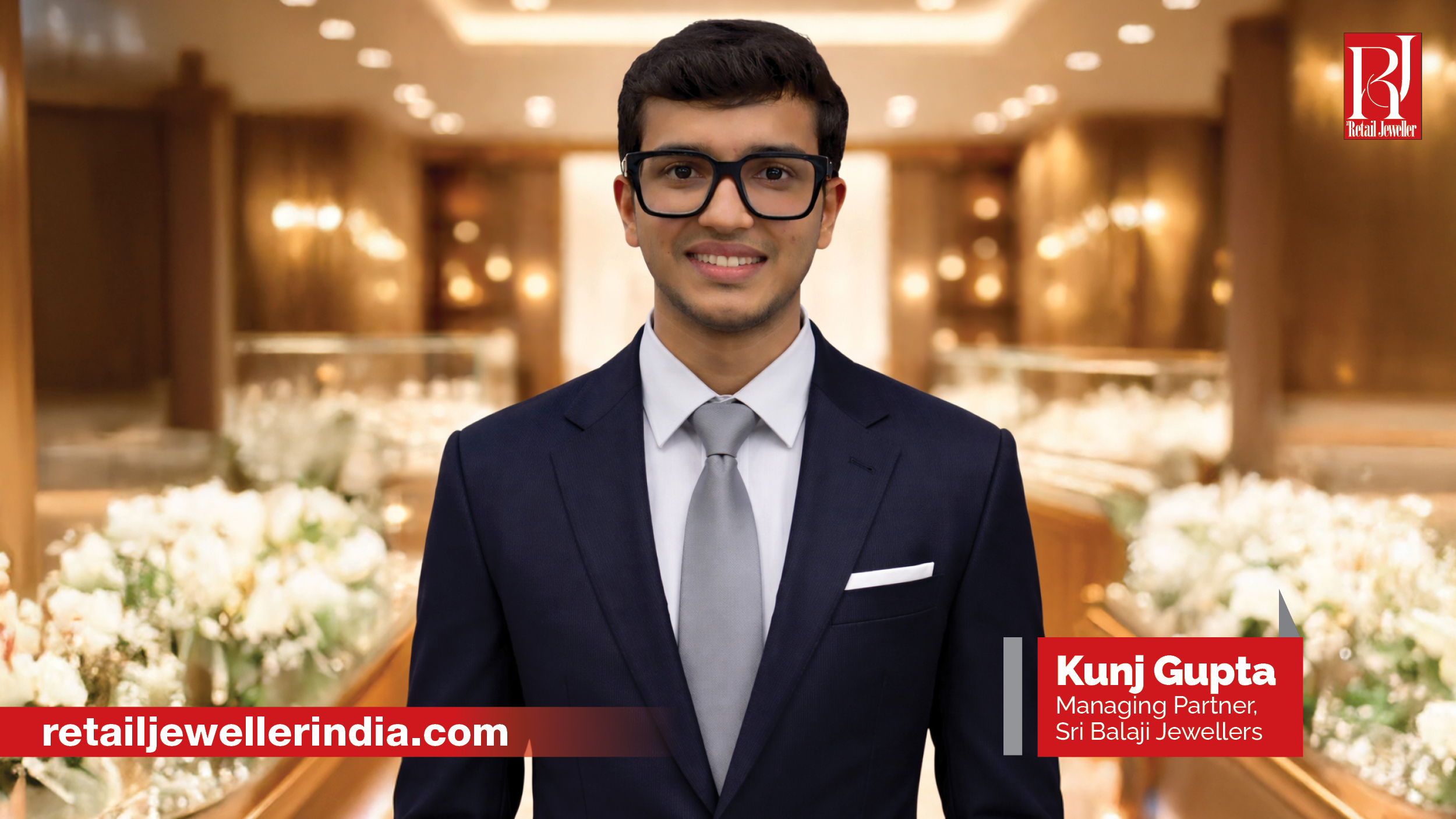

Rising gold prices are reshaping how customers buy jewellery, and how forward-thinking retailers respond. Kunj Gupta, Managing Partner at Sri Balaji Jewellers, Hyderabad, saw an opportunity where others saw a crisis. With a background in diamond assortment, CAD, and production from Surat, he redesigned his entire product philosophy around lightweight, multipurpose jewellery—engineering pieces that serve five to six occasions, not one.
Edited Excerpts:
TRIGGER
The sharpest business signals often come from the shop floor, not the boardroom. When gold prices surged over two to three years, the impact was immediate; customers wanting bridal, gold, and diamond jewellery were hitting affordability walls. At Sri Balaji, footfall told the story: buyers were entering the store, falling in love with a product, and walking away because the price point no longer made sense for a single-occasion piece. The trigger wasn’t a data report; it was a pattern in customer conversations. To address this, we identified a gap the market hadn’t filled: multipurpose jewellery in lighter weights that justifies its price across multiple uses and occasions. The goal was to make each purchase a value-driven investment, fundamentally based on the utility of the purchase. Identifying that unmet demand early, gave us the competitive edge to act decisively.
EXECUTION
The execution of it all began with consistency and research, with the mix of getting directly involved in production. Drawing on my diploma in diamond assortment, CAD (Computer-Aided Design), I sat with my team of karigars personally and challenged the conventional weight-to-wastage ratio. Most goldsmiths default to 10 per cent wastage on 100 grams; we restructured that model—offering 12 per cent wastage on 75-80 grams, keeping quality intact while reducing weight meaningfully. After visiting 10-15 factories and identifying karigars who genuinely wanted to commit towards innovation, and then we built a production unit to deliver lightweight, detachable, multipurpose designs. Our cost of production remains 1-2 per cent above market, intentionally. That premium affords an uncompromised finish, a lifetime free service promise, and zero inventory bloat. An organic Instagram strategy, with no paid boosts, and driving 60-70K views per post with a consistent minimum of 10 new families and in-store customers per product launch.
RESULT
This transition has led us to observe that eighty per cent of our customer base has shifted to multipurpose jewellery, and the broader market has followed in as well. Bestsellers sell out within seven to ten days. Repeat customers that have been built over seven years remain our strongest commercial indicator, a metric no advertising budget can manufacture. For industry experts and individuals operating in this sector, should bear in mind only one lesson: demand must always exceed supply. When it does, the product commands respect and the brand commands loyalty. Buyers spending 10-15 lakhs on a piece now expect true versatility, that is, owning jewellery that transitions across five to six occasions without looking like it was designed for just one. Multipurpose is not a product category; it is the market direction. And businesses designing ahead of it will lead the future.
As told to
Xena Aayesha Stephen
The Retail Jeweller