





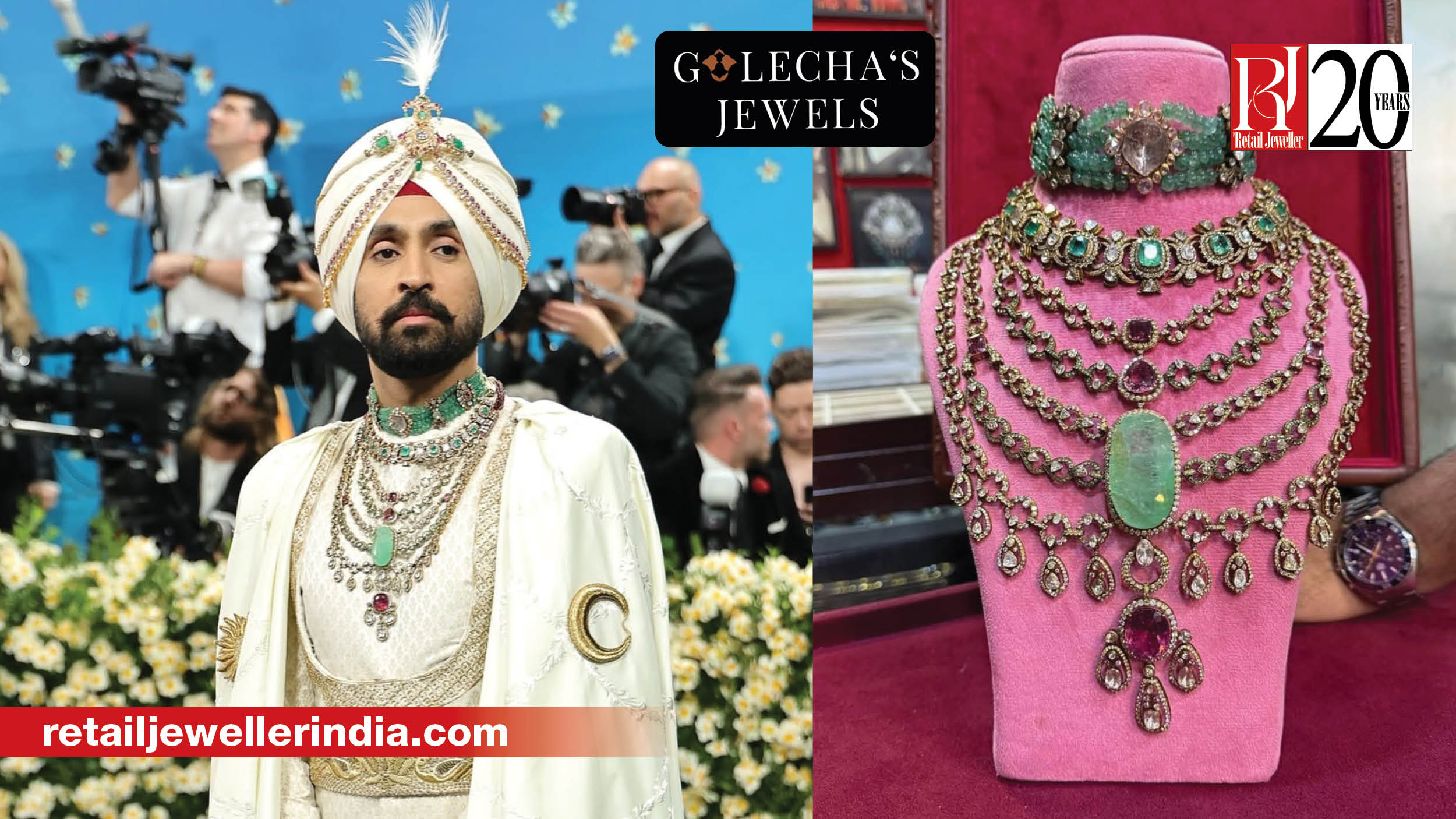
As the Punjabi singer-actor chose to adopt Patiala ruler Maharaja Bhupinder Singh’s opulent regal look for the event, Golecha’s Jewels set out to re-interpret the Maharaja’s famed jewellery pieces merging historical grandeur with the Met Gala’s theme of Black Dandyism
Jaipur: When global music sensation and actor Diljit Dosanjh made his much-anticipated debut at the Met Gala 2025, all eyes were on his opulent, regal look that paid homage to Maharaja Bhupinder Singh of Patiala. At the centre of this regal showcase was a layered diamond necklace meticulously handcrafted by luxury jewellery house Golecha’s Jewels, a modern ode to the Maharaja’s famed Patiala Necklace, originally designed by Cartier in the 1920s.
In conversation with the Retail Jeweller India, Manav Golecha, Founder, Golecha’s Jewels, detailed the creative process of crafting the extraordinary piece that seamlessly merged historical grandeur with the Met Gala’s theme of Black Dandyism. “It all started when Diljit expressed his desire to recreate the iconic look of Maharaja Bhupinder Singh,” said Golecha. “Around the same time, his stylist reached out to us, and that’s when we began working closely to conceptualize and design the jewellery.”
The centerpiece of the ensemble was inspired by the legendary Patiala Necklace. “What people don’t often realize is that the term ‘Patiala Necklace’ refers not just to a specific piece but to a distinctive style—defined by its cascading layers and opulent fall,” Golecha explained. “For Diljit’s look, we incorporated multiple elements: his bajubandh, headgear, a layered choker, a vivid emerald necklace, and finally, the Patiala-style necklace itself.”
A symbol of colonial-era opulence, the original choker boasted 2,930 diamonds, including the world’s seventh-largest diamond, the De Beers. After mysteriously vanishing in 1948 and later resurfacing stripped of its jewels, the piece became an emblem of lost grandeur.
Recognizing the original necklace’s historical and aesthetic significance, the brand set out to reinterpret it for a contemporary audience while maintaining its regal essence. This effort went beyond mere replication—it was about restoring a lost icon of heritage and bringing its story back into the cultural spotlight.
The brand has seen a dramatic spike in global engagement since Diljit Dosanjh’s Met Gala appearance. “The response has been phenomenal,” said Golecha. “We expected a strong reaction, but the scale and speed at which it went viral surprised us.”
Following the event, Golecha’s Jewels has been flooded with enquiries—not just about the necklace, but for other bespoke pieces as well. “Clients, both old and new, from across the globe are reaching out,” Golecha confirmed.
Riding high on the success of the Met Gala collaboration, Golecha hinted at bigger plans for the future. “This is just the beginning,” he said. “We hope to continue this journey with Diljit and his team, and we’re already exploring fresh concepts for upcoming red-carpet appearances.”
Established in 1998 at Jaipur, Golecha’s Jewels specializes in traditional Jadau jewellery adorned with diamonds, emeralds, sapphires, rubies and other precious gemstones. With a heritage of crafting exquisite pieces for aristocracy, royalty and leading figures in the Indian film industry, the brand has firmly positioned itself as a prominent name both nationally and internationally.
Notably, Golecha’s Jewels played a pioneering role in introducing the use of real jewellery in Indian cinema, with contributions to films such as Umrao Jaan, Raabta, Mirzya and Drona.
The jewellery house has also designed 14 international pageant crowns, including those for Miss Universe India, and has been commissioned to design jewellery for high-profile couples such as Abhishek Bachchan-Aishwarya Rai and Priyanka Chopra-Nick Jonas during their nuptials.
Written by Megha Misra
Retail Jeweller India Exclusive