

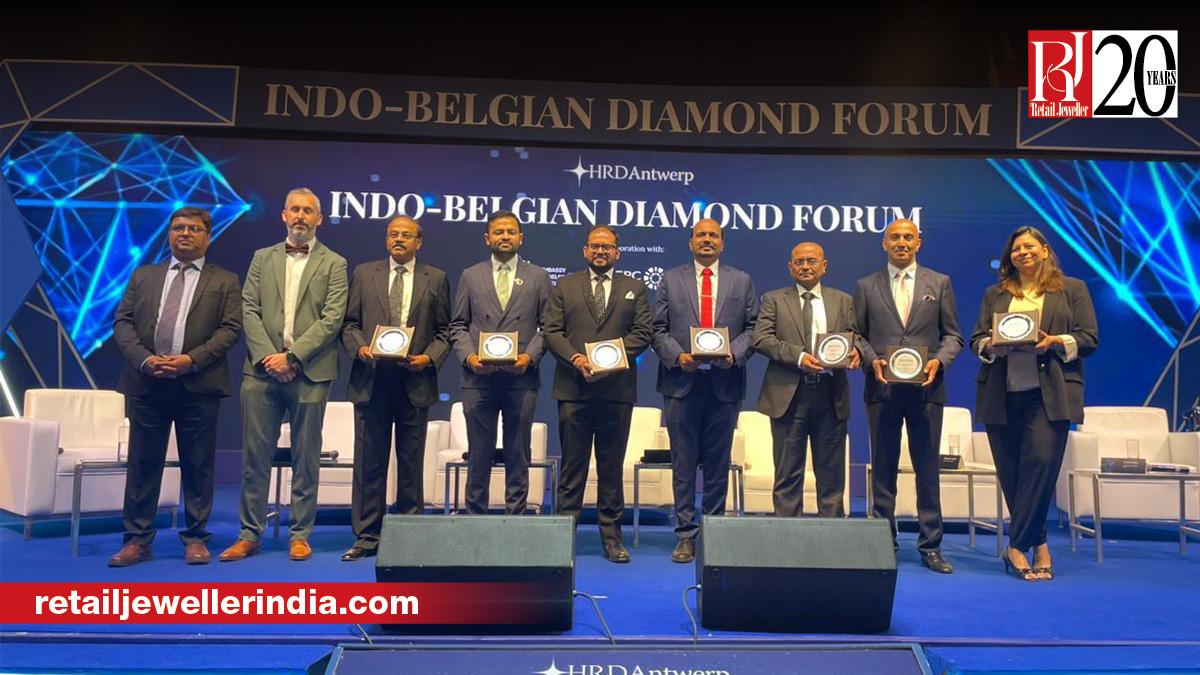

The forum underscored the strategic importance of the India-Belgium diamond corridor, combining India’s manufacturing leadership with Antwerp’s expertise in certification and compliance
New Delhi: In a powerful step towards strengthening the future of natural diamonds, Europe’s leading diamond and jewellery certification authority HRD Antwerp brought together global industry leaders, policy-makers, retailers and trade stakeholders at the Indo-Belgian Diamond Forum in New Delhi, marking a decisive move to take the natural diamond story to the next level.
Hosted at the residence of the Ambassador of Belgium in New Delhi, the exclusive thought leadership forum was organized by HRD Antwerp in collaboration with the Embassy of Belgium in New Delhi, Flanders Investment & Trade and the Gem & Jewellery Export Promotion Council of India (GJEPC). The gathering went beyond dialogue, positioning itself as a strategic convergence of institutions and ideas that are actively shaping the next phase of growth, trust and consumer relevance for natural diamonds.
At a time when the industry is navigating evolving consumer behaviour, rising competition from lab-grown diamonds and shifting global trade dynamics, the forum reinforced a clear and optimistic direction: the future of natural diamonds lies in deeper collaboration, stronger story-telling and a unified push across the value chain. The combined presence of HRD Antwerp, GJEPC and Indian Natural Diamond Retailers Alliance (INDRA) highlighted a shared commitment to elevating the category and unlocking its full potential in both domestic and global markets.
The event spotlighted the enduring India-Belgium partnership, long recognized as one of the strongest corridors in the global diamond ecosystem. While India continues to lead as the world’s largest manufacturing hub, Antwerp remains a global centre for certification, compliance and diamond trade infrastructure—together forming a complementary and future-ready alliance.
Addressing the gathering, Didier Vanderhasselt, Ambassador of Belgium to India, highlighted the strength and momentum of this relationship. “The depth of the India–Belgium relationship is reflected in the diamond trade, with diamonds and precious stones accounting for nearly 40% of Belgium’s exports to India and 25% of its imports in 2025. At the same time, the economic relationship between the EU and India is stronger and more ambitious than ever, with recent trade developments creating a more open framework and lowering tariffs across diamond-related categories,” he added.
While acknowledging industry shifts such as lab-grown competition and tariff pressures, the Ambassador pointed to the immense opportunity emerging from India’s rapidly expanding jewellery market. He emphasized that the India-Belgium diamond corridor is uniquely positioned to drive the next phase of growth by combining scale, skill and trust.
Highlighting the importance of long-standing global partnerships and collaborative dialogue in the diamond trade, Paul De Wachter, CEO of HRD Antwerp, said, “The Indo-Belgian Diamond Forum reflects our shared commitment to a strong, transparent and future-oriented diamond industry. Belgium and India have been partners in this sector for decades, and this dialogue is essential to shaping what comes next.”
Kirit Bhansali, Chairman, GJEPC, described the forum as a critical platform to align global perspectives and unlock new opportunities. He highlighted India’s growing leadership role in the global diamond ecosystem, noting that the country will serve as Chair of the Kimberley Process in 2026, reinforcing its commitment to transparency, responsible sourcing and ethical practices.
He also pointed to key domestic measures, including new Bureau of Indian Standards norms aligned with global guidelines, ensuring clearer classification and disclosure across natural diamonds, lab-grown diamonds and imitations, further strengthening consumer trust.
Expanding on the growth outlook, Bhansali said, “The most exciting growth story lies in India’s domestic jewellery market, which is projected to grow from $85 billion to nearly $130 billion by 2030, with diamond jewellery expected to expand from $9 billion to around $15 billion. At the same time, Indian retailers are steadily expanding their global footprint, supported by trade agreements that are improving market access and strengthening exports.”
A central pillar of this growth strategy is INDRA, a joint initiative by De Beers and GJEPC, designed to strengthen natural diamond sales through education, marketing and collaboration. Positioned as a digital ecosystem for retailers, INDRA represents a clear shift towards structured category building.
Through a 360-degree approach, INDRA has already rolled out impactful campaigns such as ‘Love, from Dad’, ‘Love, from Bestie’ and ‘Love, from Universe’, repositioning diamonds from occasion-led purchases to everyday emotional expressions. These campaigns are being supported by strong on-ground activations, including roadshows and retailer onboarding drives across key tier markets like Nagpur, Coimbatore, Kochi and Madurai.
With a defined goal of increasing natural diamond penetration in India from around 15% to 25%, INDRA is unlocking new demand among younger consumers and emerging middle-class buyers—clearly demonstrating how the industry is moving forward with intent and structure to take the category to the next level.
A central feature of the evening was a high-level panel discussion on ‘The evolving global diamond landscape: trade, transparency and industry alignment’. The discussion featured Shaunak Jitendra Parikh, Vice Chairman, GJEPC; Toranj Mehta, VP Marketing, De Beers India; Sabyasachi Ray, Executive Director, GJEPC; Oushnik Chandra, CEO, P. C. Chandra Jewellers; Priyal Shankar, Director – Brand & Technology, Shivam Jewels and Ramakant Mitkar, Managing Director India, HRD Antwerp. Setting the tone, moderator Prasad Kapre, industry analyst and consultant at Blue Sky Business Management Group, introduced the panel as “dream merchants”, noting that diamonds are not merely sold as products, but as aspirations and emotions.
The panel opened with a discussion on responsible leadership and transparency. Shaunak Jitendra Parikh from GJEPC argued that leadership today must bring the entire pipeline together, from mine to retail, and extend beyond miners, manufacturers and retailers to include governments, financial institutions and every stakeholder in the chain. In a global business like diamonds, he said, trust and integrity can only be built through alignment and collaboration.
He later returned to the question of how natural diamonds can move from a supply-led model to a value-led one. He said that shift begins with communication, and added, “The diamond category must connect more powerfully with Gen Z and respond to the realities of a digital-first world. Education, modern marketing and sharper story-telling will be key, and by 2035, success will depend on stronger consumer demand, with Gen Z viewing natural diamonds as a meaningful luxury purchase.” He also referred to the Luanda Accord as one of the industry’s most important recent steps, because it brought miners and the midstream together to create a fund for promoting natural diamonds. On the India-Belgium relationship, he said the two countries are deeply intertwined, with HRD Antwerp continuing as a niche hub for very high-value stones and India remaining the scale centre for cutting and polishing.
Priyal Shankar from Shivam Jewels emphasized that responsible leadership must run across the entire supply chain, from mine-level compliance to fair manufacturing practices, respect for craftsmanship, innovation and transparent consumer communication. He also highlighted the need for clear product distinction, noting that initiatives like Titan’s way of entry into lab-grown diamonds reinforce the importance of helping consumers understand what each category represents and who it is meant for.
On trade, he noted that FTAs go beyond tariffs by enabling new collaborations, citing how a European media body recently approached Shivam Jewels to create a platform connecting Indian and European jewellers. He added that with AI reshaping consumer behaviour, businesses are now tracking digital interactions more closely and using those insights to develop new designs and offerings that align with evolving demand.
On the trade front, Sabyasachi Ray from GJEPC said the India-EU FTA is highly significant, though its finer implementation details, especially around procedures and certification, will become clearer only after ratification by the European Parliament. He noted that India has already ratified it. He also referred to FTAs with the European Free Trade Association (EFTA), the UK, UAE and Australia, arguing that India is increasingly using bilateral agreements well at a time when multilateralism has weakened. Ray made an important distinction between raw diamonds and finished products, noting that duties matter mainly for end goods rather than rough diamonds, which generally move duty free. In his view, the true opportunity in FTAs lies in easing trade in jewellery and finished products with consuming nations. Most importantly, he concluded, “With the US and Middle East together accounting for nearly 65% of the market and both facing disruptions, exporters can no longer rely on broad market bucketization. Europe, with its 27 distinct markets, now represents a major opportunity, but one that will require targeted market-by-market strategies.”
From a retail perspective, Oushnik Chandra from PC Chandra Jewellers said, “The next phase of diamond retail will be defined by experience, education and personalization. In India, demand for diamonds already exists organically, and the real opportunity lies in how the category is marketed. Evolving consumer expectations are making showroom experience and product understanding critical to driving diamond conversions.” He illustrated this shift with an example of a bride using AI tools like ChatGPT to visualize jewellery before making a purchase, highlighting how technology is beginning to influence decision-making. He also noted that AI is strengthening the backend of diamond retail, from demand forecasting to inventory planning, helping retailers align more closely with consumer demand and improve precision in selling.
Toranj Mehta from De Beers brought the discussion back to category building. She said the natural diamond dream must now be rebuilt both emotionally and rationally, and that the old ways of communication are no longer enough. In her view, both the buyer and the seller need to be educated and updated if the category is to remain compelling. She described INDRA as a critical retail empowerment tool because it gives jewellers access to training on natural diamonds, guidance on running a diamond business and ready-to-use communication tools for platforms like social media, WhatsApp and Instagram. What matters most, she said, is the last mile, because no matter what consumers read online, the final conviction still rests with the salesperson.
Mehta also argued that India’s design heritage is extraordinary but often under-leveraged because of how widespread and varied it is. She said the country needs to think more seriously about turning that craftsmanship and diversity into globally recognized brands through long-term investment and patience. She said, “On consumer demand, the sheen of the natural diamond dream has dimmed somewhat over the past two decades, and that the category must now be rebuilt through both emotional relevance and sharper differentiation. That includes creating new purchase occasions beyond weddings, such as second piercings or bracelet exchanges, especially for younger buyers.” Looking ahead to 2035, she offered a specific target: if India’s natural diamond penetration rises from about 15% to around 23%, the category will be in a very strong place.
Ramakant Mitkar from HRD Antwerp rounded up the panel with the certification perspective. He said labs play a foundational role in consumer trust by offering critical disclosure and information on origin, treatments and identification. With their grading integrity and technical depth, labs help create confidence in the product. He also noted that labs sit on a large amount of market intelligence, tracking shifts in grading patterns, product mix and consumer behaviour. On future Indo-Belgian collaboration, he pointed to the India-EU trade agreement, Belgium’s eased immigration norms for assorters and polishers, and the growing demand for fancy-shaped diamonds as three major areas of opportunity. He also argued that branding natural diamonds can no longer be left to one player alone. Instead, he said, organizations such as De Beers, HRD Antwerp, GJEPC, the Antwerp World Diamond Centre (AWDC) and the Natural Diamond Council must work together to build stronger category recognition through story-telling and communication.
Among the 330 guests at the event were leading manufacturers, retailers, industry executives, policy-makers and diplomatic representatives, all gathered to explore the forces reshaping natural diamonds, global trade and the luxury market. What emerged from the Indo-Belgian Diamond Forum was a clear sense that the natural diamond industry is entering a new phase, one that will depend on tighter global collaboration, smarter retail capability, stronger consumer education and a more unified story. The coming together of HRD Antwerp, GJEPC and INDRA suggested a serious and increasingly coordinated intent to take the natural diamond story to the next level.
Founded in Antwerp, the historic heart of the diamond trade, HRD Antwerp has 15 laboratories worldwide across Europe, India and the UAE. It works to build consumer confidence through independent certification, scientific research and transparent grading standards.
Retail Jeweller India News