



The first consignments marked the beginning; the more consequential story will be how the agreement reshapes what the UK sources from India and how Indian manufacturers respond to that demand.
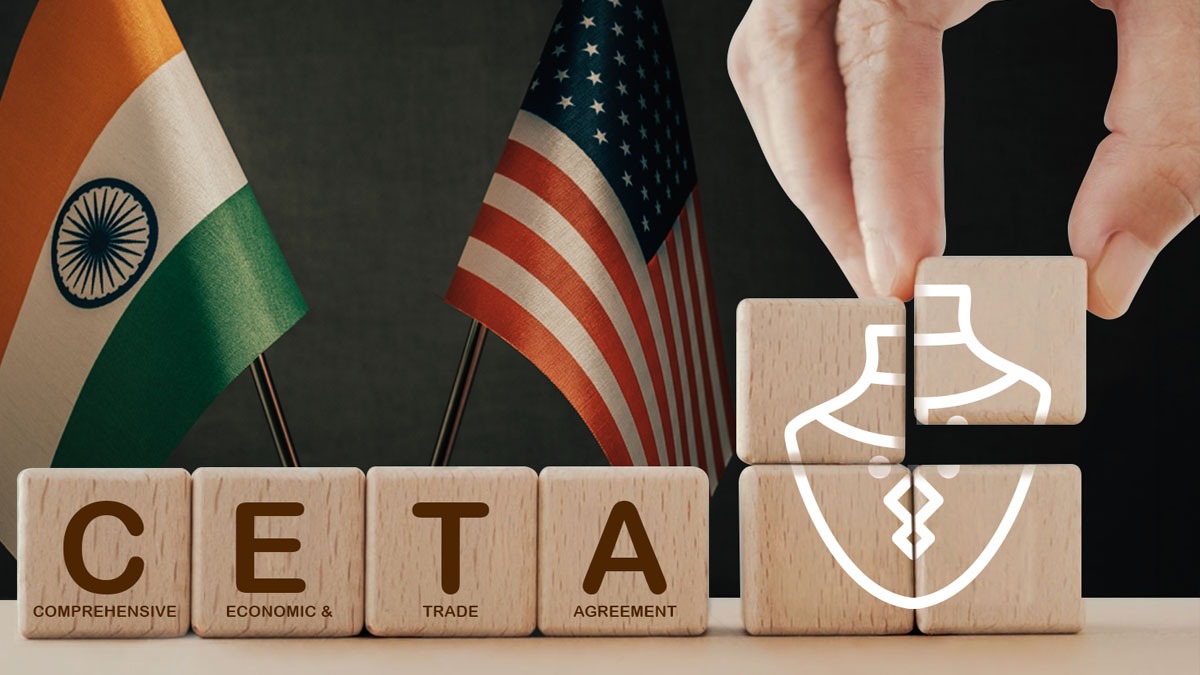
When the India–UK Comprehensive Economic and Trade Agreement came into force on July 15, 2026, the gem and jewellery sector was among the first to translate the new framework into business. More than 30 Indian exporters shipped approximately US$10 million worth of gold, diamond, silver and platinum jewellery from New Delhi, Mumbai, Surat, Jaipur, Chennai and Kolkata on the first day.
PureJewels was among the UK businesses to act on the agreement immediately, dispatching a consignment of 22-carat gold and diamond-studded jewellery from Surat.
“This first shipment shows the UK–India CETA moving immediately from policy into practical trade. PureJewels combines British design and craftsmanship with India’s specialist manufacturing expertise and scale. The real opportunity is structured collaboration that strengthens both jewellery industries,” says Jayant Raniga, CEO, PureJewels.

For India’s jewellery industry, the immediate advantage is improved price competitiveness. CETA eliminates UK import tariffs of up to 4% on eligible Indian gems and jewellery. The UK is already India’s fifth-largest gem and jewellery export market, with shipments valued at about US$754 million in FY2025-26. GJEPC expects exports to rise to nearly US$2.5 billion over the next few years, while bilateral gem and jewellery trade, estimated at US$3.83 billion in 2025, could move towards US$7 billion.
Mehul Lodhiya, Owner/Director of Nysa Creations Ltd., a UK-based B2B wholesale jewellery business, was among the first in the trade to experience the new framework firsthand. Nysa was part of the first group recognised for receiving jewellery under CETA, and Lodhiya says its consignment was the first among that group to reach the UK. He describes being part of the first movement as an immensely proud moment for the company.
The occasion was formally marked at the High Commission of India in London, where commemorative certificates were presented by His Excellency Kumaran Periasamy, High Commissioner of India to the United Kingdom, and Nidhi Mani Tripathi, Minister (Economic), High Commission of India. Companies recognised included Malabar Gold & Diamonds Ltd., Nysa Creations Ltd., PureJewels Ltd., Taj Jewels, Kalyan Gold & Diamond Jewellery Ltd., Siddharth Jewellery (UK) Ltd. and Fine Jewels Ltd.
Beyond the recognition, Lodhiya sees a clear commercial impact. For Nysa specifically, he says the duty benefit works out to around 2% on the jewellery it currently sources, a saving he considers significant across regular import volumes. He expects the improved economics to contribute to a noticeable increase in trade between India and the UK in the coming months.
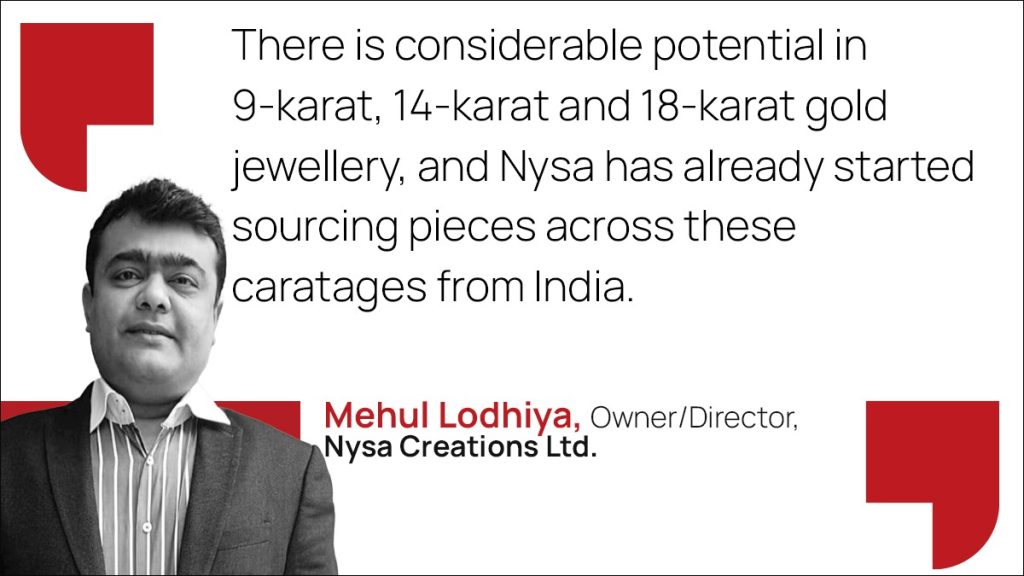
On where fresh business could emerge, Lodhiya says, “There is considerable potential in 9-karat, 14-karat and 18-karat gold jewellery, and Nysa has already started sourcing pieces across these caratages from India.”
For Indian manufacturers, this could become one of CETA’s more consequential effects. The opportunity may extend beyond increasing volumes in established export categories to developing jewellery more specifically around British preferences in caratage, weight, design, everyday wear and price points. If demand across 9K, 14K and 18K gold strengthens, the UK could emerge as a more differentiated market for Indian manufacturing rather than simply a larger destination for existing products.
GJEPC has said it is working with UK partners to bring buyer delegations to IIJS Bharat – Premiere 2026 and the International Gem & Jewellery Show in Jaipur, alongside capacity-building and awareness initiatives aimed at helping exporters make greater use of the new trade environment.
“We are expecting around 30 to 35 companies and delegates from the UK to participate in IIJS Bharat – Premiere 2026,” says Lodhiya.
CETA has created the conditions for a deeper India–UK jewellery relationship. For India’s jewellery industry, that could mean a larger role within the UK jewellery supply chain. Its longer-term significance will be measured not only by how much exports grow, but by whether UK buyers broaden what they source, Indian manufacturers respond with products better suited to the market and these early connections develop into sustained business.
Written By
Akhila Nair