




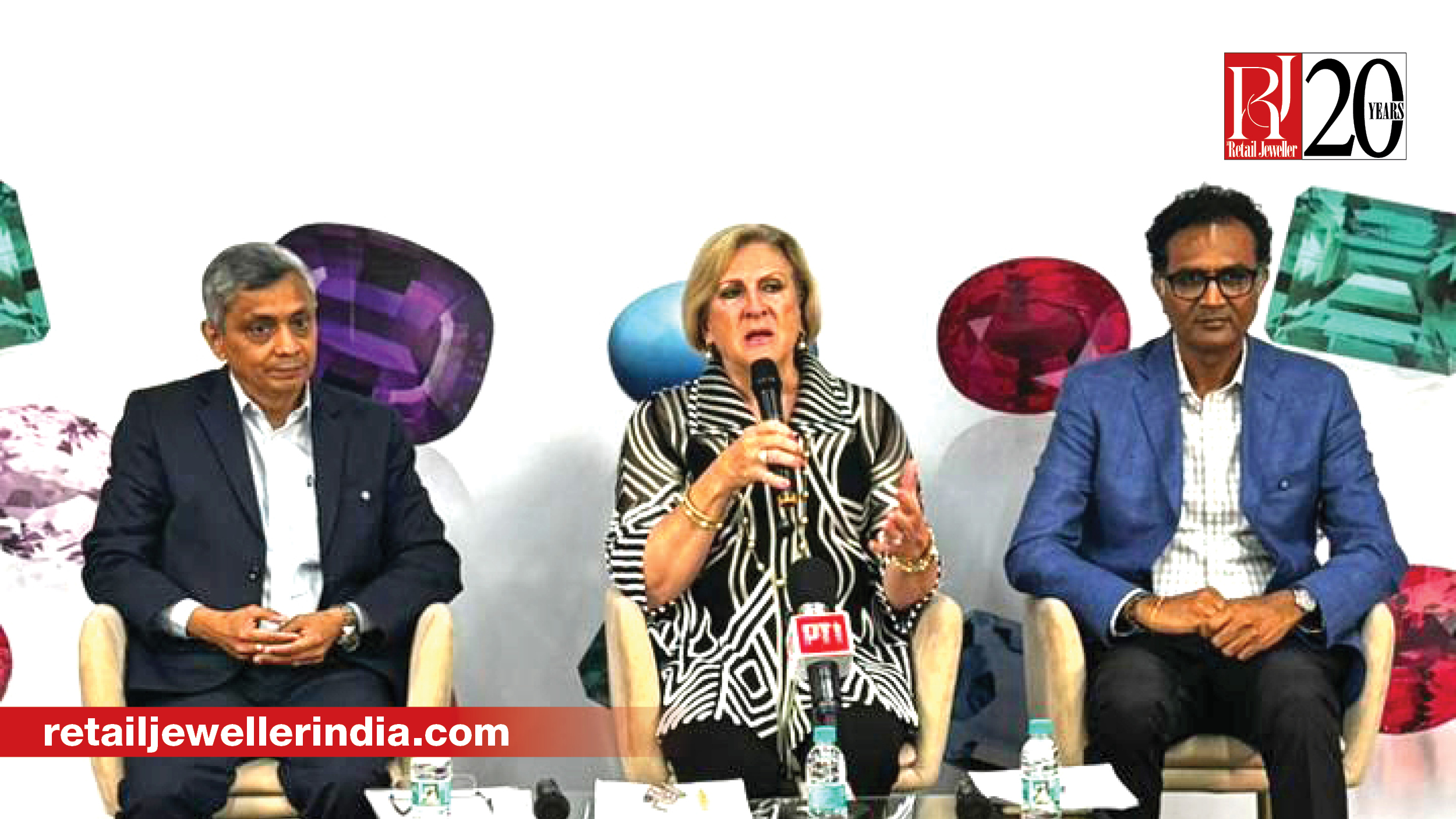
Susan Jacques, President and Global CEO, GIA, who was in Mumbai this week, recognized India’s growing influence in the global diamond value chain and discussed how GIA plans to sharpen its India strategy with consumer education and other new initiatives
Mumbai: The Gemological Institute of America (GIA) is preparing to expand the scope of its services in India, by entering certification of gold and studded jewellery from August 2025. The GIA will formally launch its jewellery certification services in India during the IIJS Premiere, to be held in Mumbai from July 30 to August 4, 2025. The service has already been tested through a pilot for the last two months and comes on the back of the successful launch of a similar service in the United States.
At an event held in Mumbai on June 26, Susan Jacques, President and Global CEO, GIA, Pritesh Patel, Senior VP and COO, GIA India and Sriram Natarajan, MD, GIA India, announced GIA’s entry into jewellery grading and certification services, while discussing the paradigm shift in the Indian diamond industry and GIA’s future plans in India. Besides certification, the focus of the institute’s India strategy will be consumer education programmes aimed at building lasting trust among domestic and international buyers, and other new initiatives.
Highlighting India’s growing influence in the global diamond value chain, both in consumption and manufacturing, Susan Jacques, President and Global CEO, GIA, said, “In 2005, India represented just 2% of global diamond consumption. By 2025, that number has jumped to 11%. The Indian market is incredibly important because of its deep cultural connection to jewellery, and its dominant role in diamond manufacturing.”
Mumbai and Surat are now home to GIA’s two largest laboratories worldwide, highlighting the country’s strategic importance to the institute. “We’re proud that 10 out of every eleven diamonds globally are processed in India. It’s an industry centre like no other,” noted Jacques, who announced her retirement earlier this year, and will be succeeded by Patel from August 4, 2025. (Read our earlier report on Pritesh Patel’s nomination for the global role here)
Elaborating on the jewellery certification services, Sriram Natarajan, MD, GIA India, said, “We’ve been working closely with US retailers who require jewellery certification for items manufactured here in India. That service is now gaining momentum, and we’re piloting it with Indian manufacturers for the local market as well.”
Unlike the BIS hallmarking system, which certifies gold purity, GIA’s grading reports will include comprehensive details about the studded components — diamonds and, eventually, coloured stones — along with information on metal quality. “This is over and above BIS certification,” Natarajan added. “Consumers will receive a complete picture of what they are buying, not just the gold but the entire piece.”
Education: Core focus area
Beyond laboratory services, GIA is taking an education-first approach to long-term market development. “Consumer confidence is critical to the survival of our industry. Without it, we simply don’t exist. Every decision we make — whether in grading, education or innovation — is grounded in that purpose,” declared Jacques.
“We see India as a key growth market, with younger consumers, rising affluence, and a strong appetite for luxury,” noted Pritesh Patel, Senior Vice President and COO, GIA India. “The way we expand in India is by educating both retailers and consumers — that’s what we’ve done in other mature markets. When trained GIA alumni enter the retail environment, they become advocates for consumer confidence.”
LGD grading redefined
Commenting on GIA’s recent decision to redefine the grading system, and not apply its 4Cs framework to laboratory-grown diamonds, Jacques said, “We are no longer using the same D-to-Z scale. It’s a man-made product, and the rarity factor simply doesn’t exist in the same way. Our role is to reduce confusion and help consumers make informed decisions. Our new grading system will clear doubts in consumers’ minds and help them distinguish between real diamonds and LGDs.”
AI integration in grading
GIA has implemented artificial intelligence in its grading processes, developed in collaboration with IBM Research. “The use of AI brings higher consistency and reliability — exactly what consumers expect from GIA,” said Patel. “We see AI as a tool to power our expertise, not replace it. Everything we do is anchored in gemological research.”
India will also see the rollout of new global services, such as jewellery authentication for resale platforms and participation in blockchain-based traceability projects. “We’ve begun collaborating with platforms like eBay in the US, and that service is now live in the UK and Japan. We do anticipate bringing it to India as well,” Patel confirmed.
GIA has also secured approval from its Board of Governors to invest in De Beers’ blockchain platform ‘Tracr’, aimed at boosting transparency across the supply chain — a development with growing relevance in the Indian market.
The institute also plans to continue expanding its pearl identification services in India, building on the region’s deep-rooted cultural and historical connection with pearls. “India is an important centre where natural and recycled natural pearls are aggregated before being distributed globally. That’s a service we began offering, and we’re seeing strong traction,” said Natarajan.
Written by Aparna Bhowmick
Retail Jeweller India Exclusive