




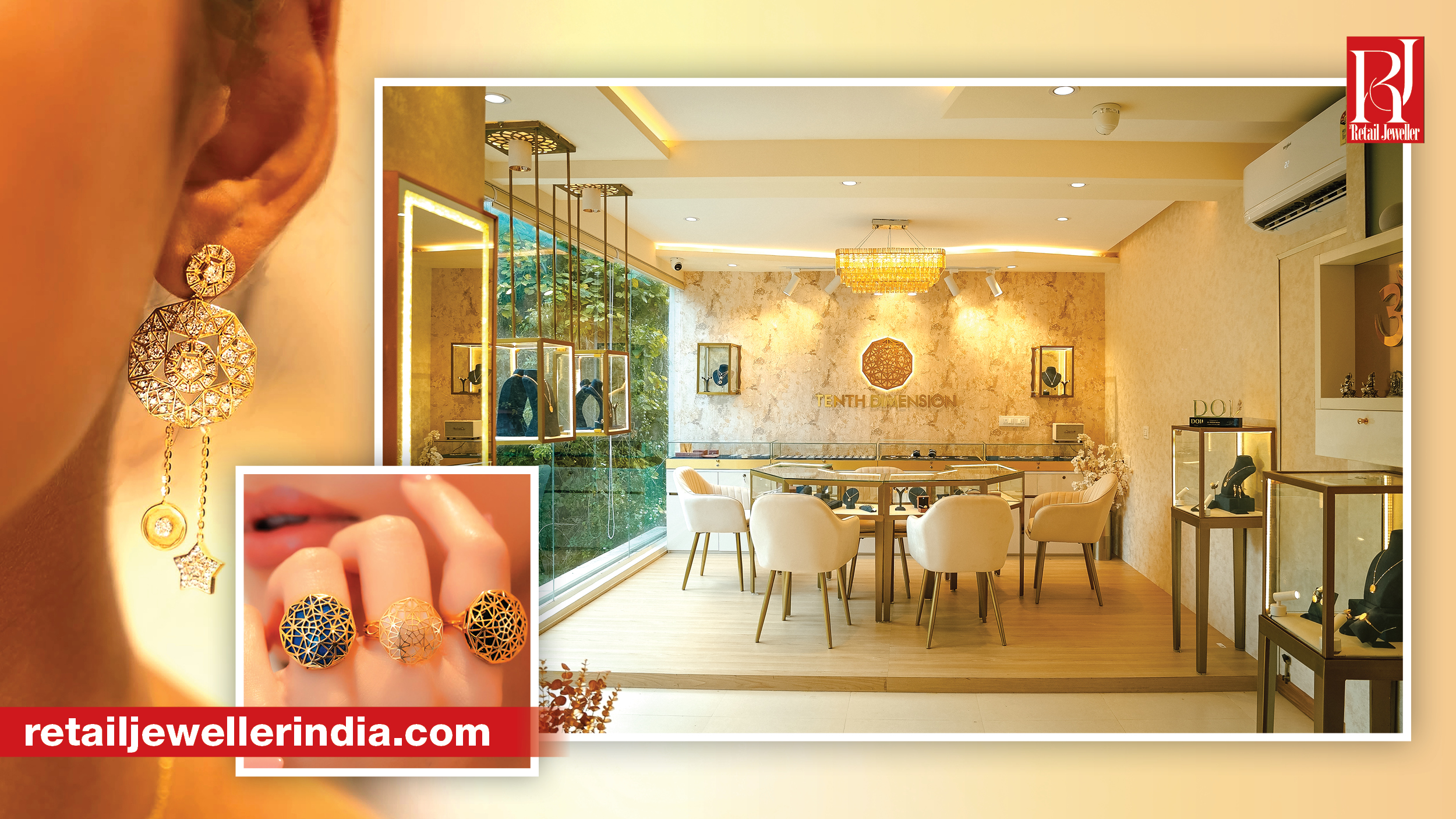

Manisha Mehta, Creative Director and Founder, Tenth Dimension Jewels talks to The Retail Jeweller about building a commercially viable boutique business through patented concepts in daily-wear designs, narrative-driven sales, and balancing scarcity with strategic growth rather than chasing mass-market volume.
by Maithili Patange
EDITED EXCERPTS
Maithili Patange (MP): Tenth Dimension Jewels is built on creations that carry deep philosophical meaning. How is the market for concept-driven designs backed by storytelling evolving?
Manisha Mehta (MM): Having exported to 23 countries in my previous venture, I realised international luxury brands relied heavily on conceptual, purpose-driven designs, yet sourced their craftsmanship and stones directly from India. I wanted to build a homegrown Indian brand offering that same global design sensibility. Our name comes from the scientific and spiritual concept that the 10th dimension is the realm of pure manifestation—where anything imagined becomes possible.
Because fine jewellery is bought during life’s happiest milestones, it is inherently a physical token of personal manifestation. Our stories don’t just decorate the product—they sell it because they mirror the consumer’s own life journey, achievements, and emotional state.
(MP): Your collections heavily feature a patented ‘Manifest’ symbol. How does protecting this unique IP support your premium positioning?
MP: Our entire brand anchors on our patented Manifest Talisman symbol, a custom geometric icon that visually houses over 15 hidden sub-motifs, like a panther for power, a butterfly for transformation, and a crown for royalty. No other global design house features a composite symbol like this.
We hold over 25 design patents, with U.S. patents pending. Securing this intellectual property is our critical business moat. In a retail environment where mass replication is rampant, safeguarding our IP ensures our limited-edition collections remain strictly exclusive. It shifts the conversation from commodity prices to design equity, allowing us to maintain premium margins protected from mass-market imitation.
MP: Why are modern buyers seeking your designs
MM: Modern women want wearable art that enhances their personality without weighing them down.
Traditional, mass-produced jewellery is often built around uniform, repetitive templates. In contrast, our process is entirely design-led. Our product cycle takes a highly deliberate five to six months from sketch to the final certified piece. We engineer every piece for multi-way versatility so a woman can transition seamlessly from a corporate meeting to an evening social event. Our consumers choose us over mass retail because our pieces serve as personal reminders of their inner strength and uniqueness. Every time they touch their earring or pendant, it triggers a positive emotional response.
MP: Operating an appointment-only atelier is highly exclusive. How do you structure your commercial framework and navigate consumer conversions?
MM: We deliberately bypass high-traffic traditional retail spaces to focus on a niche clientele with a transaction sweet spot of Rs. 1.5 lakh to Rs. 3 lakhs. Our model is relational, not transactional. Operating strictly by appointment ensures 100% personalized attention and zero walk-in friction. We also run a bespoke bridal vertical called Manifested Union, which accounts for 10% to 20% of our business. Here, couples co-create one-of-a-kind heavyweight pieces based on their personal love stories. Once delivered, that design is permanently retired. While our storytelling on Instagram drives global discovery across the US and UK, actual conversion relies on the absolute transparency of our credentials, our certifications, and the immersive aura of our physical space.
MP: Given the highly exclusive and specialized nature of this boutique model, how do you view its commercial feasibility?
MM: It is a challenge in India to shift consumer mindsets away from evaluating jewellery purely by metal weight, but the market is rapidly maturing. Boutique businesses can achieve highly profitable and impactful scale, but it requires balancing scarcity with strategic growth rather than chasing mass-market volume. We scale by controlling our exclusivity while expanding our geographic footprint intentionally. For instance, we are currently revamping our website to launch a digital ‘price-on-request’ model, expanding our Bangalore base, and actively targeting the US market. Furthermore, true scale must include a broader purpose. We recently established the 10 Dimension Foundation, ensuring a portion of all retail proceeds funds financial literacy for women and disability access in India. We are proving that a boutique brand can achieve commercial viability and scale globally, not by diluting its identity, but by remaining a luxury house with a deep soul.
By Maithili Patange
Retail Jeweller India Magazine