




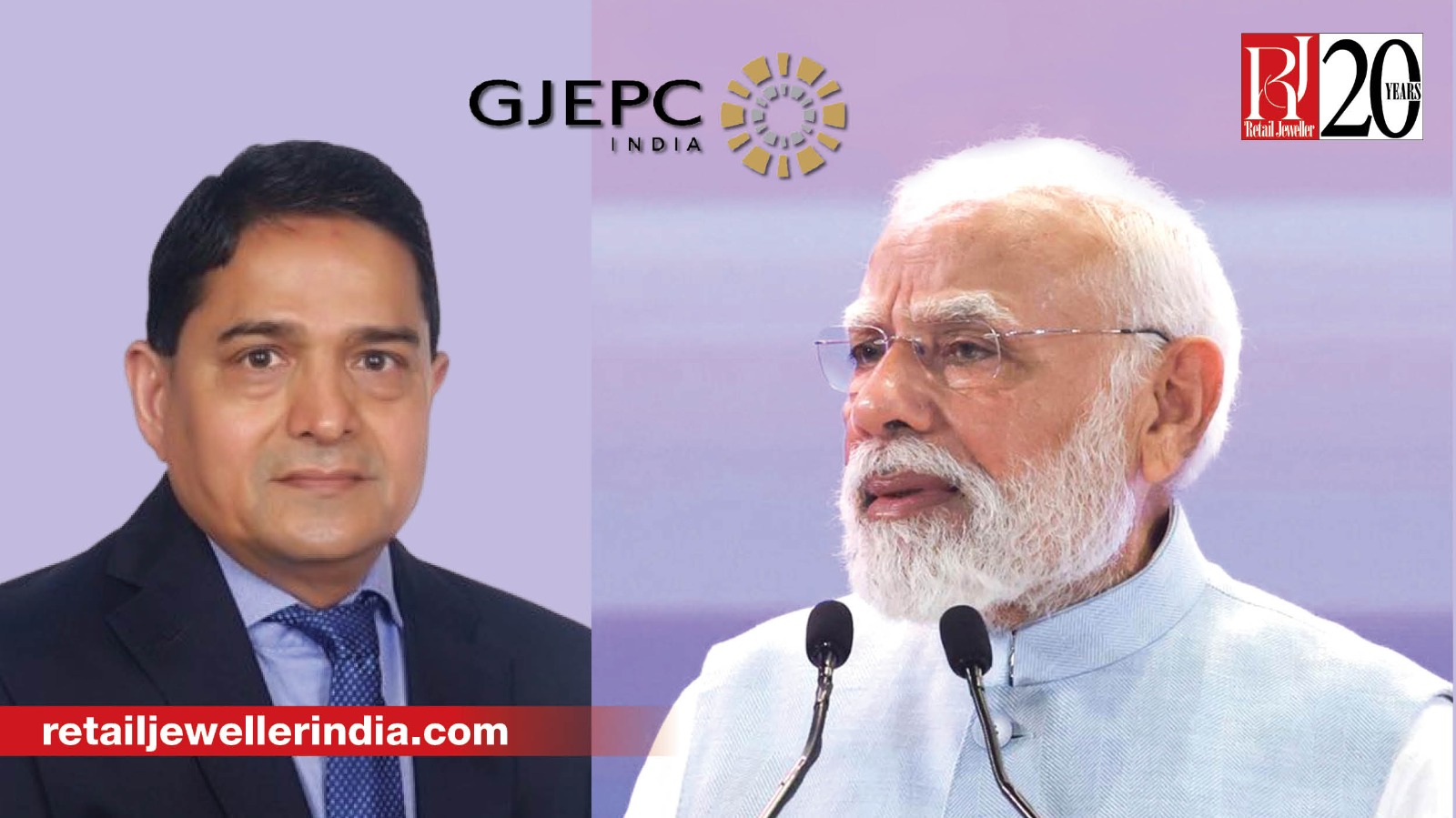

Kirit Bhansali, Chairman, GJEPC, suggested key policy reforms on behalf of the sector, which contributes US $30 billion in exports annually
New Delhi: Kirit Bhansali, Chairman, Gem & Jewellery Export Promotion Council (GJEPC), attended a meeting comprising representatives of various industry sectors that contribute majorly to India’s merchandise exports chaired by Prime Minister Narendra Modi at New Delhi on November 3, 2025. The meeting was convened to seek inputs from leading export sectors on measures to strengthen India’s competitiveness in global trade.
Bhansali, representing the gems & jewellery sector that contributes 7% to India’s merchandise exports, suggested key policy reforms on behalf of the sector, which contributes US $30 billion in exports.
“Under our Prime Minister’s visionary leadership, India’s gem and jewellery sector has achieved remarkable growth and ease of doing business. With his continued guidance, we are confident of surpassing $100 billion in exports and building a $500 billion domestic market by 2047, making India the global hub for gems and jewellery,” said Bhansali.
Bhansali’s recommendations were aimed at accelerating exports and strengthening India’s manufacturing ecosystem, while establishing an efficient and trade-friendly business environment.
1. Enhance ease of doing business in the sector: Amendment of Customs Act,1962- The gems & jewellery industry hopes to see modernization of the Customs Act, 1962, which includes implementation of a risk management system, and AI-based digital appraisals. These measures will make Customs procedures faster, more transparent, and cost-efficient — significantly enhancing India’s ease of doing business and global competitiveness.
2. Facilitate affordable credit for export business in the sector: To ensure a level playing field, GJEPC requested the Government to introduce a special scheme offering export credit at concessional rates, particularly benefiting MSME units. With India’s banking system strengthened by recent reforms, extending interest subvention and ECGC premium subsidies will further enhance exporters’ cost competitiveness and boost India’s share in global trade.
3. Early passage of the SEZ Act Amendment: Nearly 65% of India’s studded jewellery exports originate from SEZ units. GJEPC urged the Government to expedite the passage of the SEZ Act amendment, which will allow limited domestic sales with fair duty adjustment and enable optimal utilization of idle capacity during off-seasons — improving productivity, efficiency, and employment stability.
4. Formulation of a national gem & jewellery park policy: Bhansali proposed the formulation of a national gem & jewellery park policy, similar to those existing for the textile and leather sectors, to strengthen domestic manufacturing ecosystems and attract global investment into India’s gem & jewellery value chain.
He further urged the Prime Minister to prepare a white paper on the gems & jewellery sector, based on the inputs recently submitted by GJEPC to NITI Aayog and the findings of the Exim Bank report released recently.
Additionally, GJEPC has requested the Ministry of Finance to simplify export–import procedures and Customs processes for the gem & jewellery sector, vital for ensuring ease of doing business on par with leading global trading destinations. Emphasizing the broader vision, he noted that India must evolve into a true trading economy to fully realize its potential — an opportunity that remains largely untapped.
The Gem & Jewellery Export Promotion Council (GJEPC) was set up by the Ministry of Commerce, Government of India (GoI) in 1966. Since 1998, the GJEPC has been granted autonomous status and serves as the apex body of the gems & jewellery industry, representing 10,700+ members in the sector.
Retail Jeweller India News