




Gold is entering a period of structural change.
Rising prices, global uncertainty, and shifting consumer priorities are altering how gold is bought, held, and trusted.
As demand expands beyond jewellery into investment led formats, scrutiny around sourcing, standards, and transparency is intensifying. Trust is no longer implicit. It must be proven.
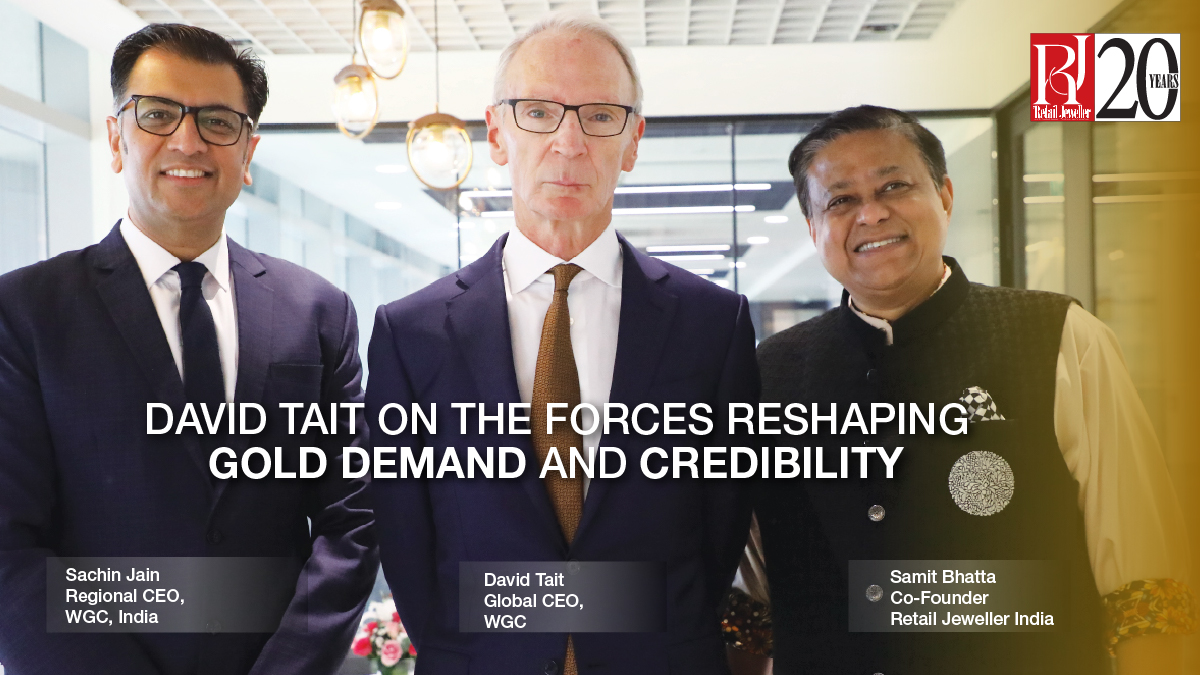
In this conversation, David Tait, CEO of the World Gold Council, shares his perspective on the demand shifts redefining the gold market and why credibility will define its next phase.
What is the most significant consumer behaviour shift the gold industry is seeing today?
The most visible shift has been the movement of demand away from jewellery towards investment bars and coins. Price is a factor, but the larger driver is uncertainty.
Geopolitical tensions, rising debt levels and economic volatility have encouraged consumers to hold gold in forms that feel directly linked to security and portfolio protection. This change is also reflected in the strong growth of gold ETFs over the past year. A meaningful share of demand has moved into these investment led formats.
What is the biggest global issue around gold that the industry still struggles to address?
Artisanal gold mining remains the most unresolved challenge. Between 20 and 30 million people are involved globally, generating close to 130 billion dollars in annual value. A significant portion of this ends up in the hands of bad actors.
This activity cannot simply be eliminated. People depend on it for survival. The real challenge lies in formalising the sector through technology, processing infrastructure and official buying systems. If brought into the formal economy, the impact would be substantial, including reduced mercury use, lower environmental damage, and a decline in child labour and exploitation.
Ignoring this issue weakens the industry’s position when it speaks about responsibility and ethics.
Why has supply chain integrity become such a central issue for gold now?
Trust has become non negotiable. Consumers, institutions and governments increasingly want to know where gold comes from and how it is produced.
In response, a global database for responsibly sourced gold was established in 2022 alongside the London Bullion Market Association. Until then, there was no unified system that allowed buyers to verify provenance with confidence.
Today, all newly produced large scale mined gold is entering this database. Major miners, refiners and financial institutions are already participating. Over time, this will become standard practice. Gold that remains outside such frameworks will face growing resistance in the market.
How is the next generation changing gold’s role as an asset?
Younger consumers are far more open to digital ownership of gold. ETFs clearly illustrate this shift.
In markets like India, the opportunity is significant. Phone penetration is high, but awareness of digital gold products remains limited. Younger buyers are comfortable holding gold in multiple forms, including jewellery, physical investment products and electronic instruments backed by physical gold.
ETFs are transparent, secure and cost efficient. They do not replace jewellery, but they broaden how gold fits into modern financial behaviour and long term wealth planning.
What does the industry need to rethink when communicating with younger consumers?
The industry needs to simplify how it speaks. Even the term exchange traded fund can feel distant or intimidating to first time buyers.
Complexity does not build trust. Clear and accessible communication does. When younger consumers understand how gold fits into their financial lives, engagement follows more naturally.
Which retail led initiative will shape the industry’s future most decisively?
Accreditation and standard setting will play a critical role.
In India, an independent body is being rolled out to raise standards across wholesale and retail. Businesses are accredited against defined benchmarks, and consumers are informed about what these standards represent.
As awareness grows, trust will increasingly shift towards accredited players. Over time, this will reshape how credibility and reliability are judged in the gold market.
What retail practice is least likely to survive over the next five years?
Compromising on gold purity to manage price pressure.
Gold derives its value from weight, purity and intrinsic worth. Diluting these fundamentals to achieve short term affordability risks eroding long term consumer confidence. While price pressures are real, sustained dilution weakens the category itself.
Once trust in purity is compromised, rebuilding it is extremely difficult.
Is the industry undermining consumer confidence in any critical way today?
Retailers and consumers are not the core issue. The larger challenge lies at a systemic and political level.
Rising gold prices are encouraging unsafe mining practices that are damaging water systems in parts of Africa and Central America. Some gold producing nations now fear higher prices because of the environmental consequences.
Addressing this requires coordinated global action. Without it, the industry risks long term reputational damage that cannot be corrected through innovation or marketing alone.
What This Means for Indian Jewellers?
For Indian jewellers, credibility will increasingly drive choice. As consumers scrutinise purity, provenance, and practices more closely, trust will be earned through transparency, standards, and consistency.
Retailers who invest in accreditation, clear communication, and uncompromising quality will be best placed to remain relevant as gold ownership expands beyond jewellery into investment and digital formats.
Written by Akhila Nair
Retail Jeweller India Feature